Furnace replacement cost (2026): gas vs. electric, and whether 96% AFUE pays
Last reviewed 2026-08-11 · pricing data as of 2026-08 · how we build these numbers
Run your own numbers in the HVAC system calculator →
Furnace pricing is unusually opaque for what is, mechanically, a metal box with a burner and a blower. Contractors quote lump sums; brand websites say "call for pricing"; national cost guides publish ranges wide enough to be useless. This guide does it differently: we start from distributor list prices you can look up yourself, apply a contractor markup we disclose, add labor at published billed rates, and then run the fuel arithmetic that tells you which efficiency tier actually earns its price difference back.
What a gas furnace costs installed in 2026
Start from numbers you can verify. When we pulled prices from HVACDirect.com in July 2026, a Goodman 80% AFUE, 80,000 BTU single-stage furnace — model GR9S800804CN — carried a published list price of $1,733, and the Goodman-built 96% AFUE equivalent, ACiQ model AQ-GR9S960804CN, listed at $1,883. A July-4th sale had both marked roughly 20% below list, at $1,386 and $1,600 — a useful reminder of how much air sits in list pricing. We build the bands from list prices so the tiers compare like for like, and let the observed sale floor anchor the low end. The 97% modulating tier, the Goodman GMVM97 class, was price-gated at retrieval, so we band it at $2,600–3,400 from the brand's price ladder and flag it as interpolated in our dataset.
From list price to installed price, the recipe is the one we use on every calculator on this site: equipment times a 1.2–1.6 contractor markup (procurement, warranty handling, overhead, profit), plus furnace-only labor of 8–12 crew-hours at the $75–150/hour billed rates published in 2026 HomeGuide and Angi guides. For the 80,000 BTU class that yields:
| Efficiency tier | Equipment list | Installed range | Typical installed |
|---|---|---|---|
| 80% AFUE, single-stage | $1,285–1,768 | $2,300–$4,600 | ≈ $3,900 |
| 96% AFUE, single-stage | $1,600–2,100 | $2,700–$5,200 | ≈ $4,100 |
| 97% AFUE, modulating | $2,600–3,400* | $3,900–$7,200 | ≈ $5,700 |
*Interpolated band — see the note above. Equipment bands run from the observed sale floor to the top of each ladder; the typical anchor is the published list price. Smaller and larger furnaces move the equipment share, not the labor: a 60,000 BTU unit runs about 7% less and a 100,000 BTU unit about 12% more than the 80,000 BTU prices shown. Sizing follows heating load, roughly 30–60 BTU of input per square foot depending on climate — an 1,800 sq ft home in a mixed climate lands in the 80,000 BTU class, which is why we price it as the default. Our HVAC sizing estimator brackets your number, and a contractor's ACCA Manual J calculation should confirm it before you sign.
Corrected 2026-08-11. The labor line behind this table was raised — typical $1,150 to $1,500, high $1,500 to $1,800 — after two public permit files were opened against it. Seattle publishes 5,887 recent single-family furnace replacements at a median declared cost of $6,100; Kansas City publishes 362 that state the efficiency, at medians of $4,868, $6,064 and $7,000 for the three tiers above. Every one of those medians cleared the ceiling this table used to print. The correction takes labor to the top of the 8–12 hour, $75–150/hour envelope this guide already declared and stops there, because closing the whole gap in the labor line would require charging more for a furnace-only visit than for a furnace-and-AC change-out. The rest of the gap is probably the equipment anchor: our list prices are Goodman's, the cheapest major brand, and where Seattle's filings name a manufacturer they say Trane 240 times to Goodman's 11. Read the two records in full: Seattle and Kansas City.
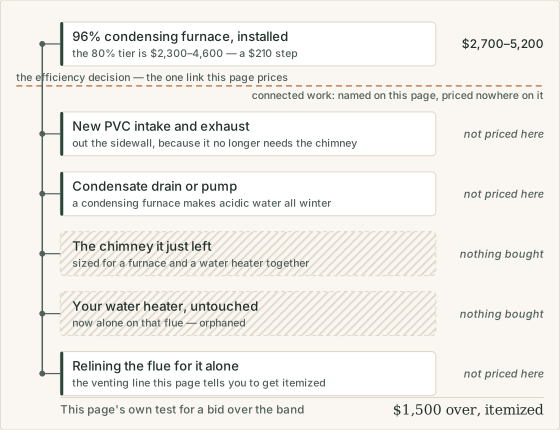
What pushes a real bid above these bands is rarely the furnace itself. It's the connected work: new PVC intake and exhaust runs for a condensing unit, relining a chimney flue, condensate pumps, code-required electrical or gas-line corrections, and awkward locations that turn a one-day job into two. A bid $1,500 over our typical with three of those items listed is more credible than a bid $500 under with none.
The 80% vs. 96% AFUE decision, in dollars
AFUE is simply the fraction of the fuel's heat that ends up in your ducts: an 80% furnace sends 20 cents of every gas dollar up the flue, a 96% furnace sends 4. At the winter 2025–26 average residential gas price of $15.63 per thousand cubic feet (about $1.51 per therm), delivered heat costs roughly $18.80 per million BTU through an 80% furnace and $15.70 through a 96% furnace.
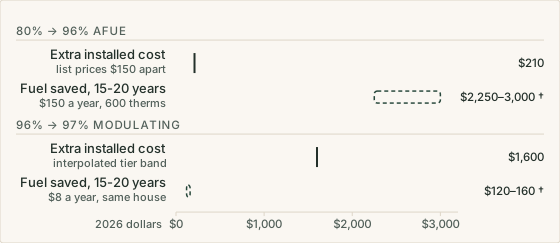
Now scale that by how much you actually burn. A cold-climate home putting 600 therms a winter through an 80% furnace gets the same delivered heat from about 500 therms through a 96% unit — about $150 a year at those prices. The list prices are just $150 apart, which makes the typical installed difference only about $210. That is a one-to-two-year payback on a machine that lasts 15–20 years: in Minneapolis or Buffalo, the 96% furnace is simply the better purchase. Even a mild climate burning 300 therms saves about $75 a year and pays the difference back in about three years. The place the decision genuinely tips is venting, not efficiency: if new PVC runs or a relined flue for an orphaned water heater add four figures to the condensing install, run the payback again with that number in it.
The step from 96% to 97% modulating is a different animal. The extra percentage point of AFUE saves about 1% of fuel — call it $8 a year on our cold-climate example — while the installed price rises by $1,600 at typical bands. What you're buying at that tier is a modulating burner and variable-speed blower: steadier temperatures, quieter operation, longer and gentler run cycles. Those are legitimate comfort reasons. They are not a payback, and a salesperson who claims otherwise is not showing you the math.
One regulatory note worth knowing before you default to 80%: under the DOE efficiency standard finalized in 2023, new non-weatherized gas furnaces must meet 95% AFUE starting in late 2028. An 80% furnace installed today is likely the last one that will ever go in that closet — which matters if the venting work for a condensing unit would be easier to do now, alongside a change-out, than alone in 2035.
Gas vs. electric furnace
An electric furnace is the cheaper machine — no burner, no venting, no gas connection, and installation is usually simpler. The operating math is where it loses. Electric resistance heat converts every kilowatt-hour to heat at 100% efficiency, but at the April 2026 national-average residential rate of 18.83¢/kWh, a million BTU of delivered heat costs about $55 — three and a half times the $15.70 a 96% gas furnace pays at average gas prices. On our 600-therm cold-climate example, that gap is roughly $1,900 a year. Where gas service exists, gas wins the running-cost contest at 2026 national prices; electric furnaces make sense mainly in mild climates with tiny heating loads or where gas is unavailable.
If you're heating with oil, propane, or electric resistance today, the modern comparison isn't gas vs. electric furnace — it's a heat pump, which delivers heat at roughly a third the cost of resistance at the same electric rate. Our heat pump vs. gas furnace guide runs that full operating-cost comparison in dollars per million BTU, including where a heat pump beats gas outright.
When furnace + AC together is the better buy
Furnaces and central air conditioners share a blower, a plenum, and an installation crew, and their lifespans overlap: 15–20 years for a furnace, 12–15 for a condenser. If your AC is within a few years of that window when the furnace dies, price the combined change-out before committing to a furnace-only swap. The combined job shares one mobilization and one crew day: 16–24 crew-hours, against 8–12 for the furnace alone. The equipment is warranty-matched from day one, and the total typically lands around $11,600 for an 1,800 sq ft home at the mid efficiency package — about what a $4,100 furnace job and a $7,500 AC job would cost separately, except that doing them separately buys two mobilizations and two crew days instead of one. Our full HVAC system replacement calculator prices that combined scope with the same disclosed method as this guide, itemized line by line; if only the cooling side is in question, the AC replacement calculator handles it solo.
The reverse also deserves a number: if your furnace is young and only the AC has failed, don't let a bid quietly upsell the furnace "while we're in there." Run the furnace-only savings math above — if the payback on early replacement doesn't clear, the honest answer is to wait.
Reading a furnace bid in sixty seconds
Ask every bidder for four numbers: the equipment model, its input BTU, the AFUE, and the labor hours. The model gets you a checkable list price — the same lookup we did. The BTU rating tells you whether they sized your house or copied the old unit's sticker (oversizing is the industry's default sin; it short-cycles and wears the machine). The AFUE tier tells you which column of our table you're in. And the hours tell you whether the labor charge is a crew day or a padding exercise. A contractor who provides all four without friction is, in our experience, the one whose final invoice matches the bid.
Frequently asked questions
How much does it cost to replace a gas furnace in 2026?
For the common 80,000 BTU size: an 80% AFUE single-stage furnace runs about $2,300–4,600 installed, typically around $3,900; a 96% AFUE unit about $2,700–5,200, typically around $4,100; and a 97% AFUE modulating unit about $3,900–7,200, typically around $5,700. Those bands are built from published distributor pricing ($1,285–3,400 for the equipment itself, spanning observed sale floors to list prices), a disclosed 1.2–1.6x contractor markup, and 8–12 hours of labor at $75–150 per hour. The labor line was corrected upward on 2026-08-11 after two public permit records — Seattle and Kansas City — put the observed median above every tier we publish; that correction takes labor to the top of its own stated envelope and still does not close the gap, so treat these as a floor for a professionally installed job rather than a midpoint.
Is a 96% furnace worth the extra cost over 80%?
In any climate with a real winter, usually yes — and in 2026 the equipment math nearly answers itself. At published list prices the Goodman-built pair we track is only $150 apart ($1,733 vs $1,883), so the typical installed difference is about $210. A home burning 600 therms a winter through an 80% furnace gets the same heat from about 500 therms through a 96% unit — roughly $150 a year at the winter 2025–26 average gas price — so the step-up pays for itself in a year or two; even a mild climate burning 300 therms pays it back in about three years against a 15–20 year furnace life. The honest caveat is venting: a condensing furnace needs new PVC intake and exhaust runs and a condensate drain, and where that work is complicated — or an orphaned water-heater flue must be relined — the true gap widens well past the equipment difference, so get the venting line itemized. The 96-to-97% step, by contrast, saves only about 1% of fuel and is a comfort purchase, not a payback.
Which is cheaper, a gas or an electric furnace?
Electric furnaces are cheaper to buy and install but far more expensive to run at national-average prices. Electric resistance heat delivers a million BTU for about $55 at the April 2026 average rate of 18.83 cents/kWh, while a 96% gas furnace delivers the same heat for about $15.70 at winter 2025–26 gas prices — three and a half times cheaper. If you don't have gas service, the modern alternative worth pricing is a heat pump, which delivers heat at roughly a third the cost of electric resistance.
How long does a furnace replacement take?
A straightforward like-for-like swap is 8–12 crew-hours — one working day. Add time (and money) if the new furnace is a condensing model that needs new PVC intake and exhaust runs, if the old flue must be relined for an orphaned water heater, or if the furnace lives somewhere genuinely awkward like a low crawl space or a packed attic.
Should I replace the furnace and AC at the same time?
If both are past roughly 12–15 years, pricing the combined job is the financially safer move: a full change-out shares one crew day, one mobilization, and warranty-matched equipment, so it costs meaningfully less than two separate projects a year apart. If the AC is young and the furnace fails, a furnace-only swap is perfectly reasonable — just have the installer confirm the new blower is compatible with your existing coil.
Data sources
Equipment: HVACDirect.com published list prices, Goodman GR9S/GR9T and ACiQ 96% AFUE furnace ladder, retrieved July 2026 (97% modulating band interpolated and flagged in data/hvac-system.json). Labor: BLS Occupational Employment and Wage Statistics, occupation 49-9021, May 2025 national median wage $29.33/hr, series OEUN000000000000049902108, plus HomeGuide/Angi 2026 billed-rate guides ($75–150/hr). Fuel prices: EIA winter 2025–26 average residential natural gas ($15.63 per thousand cubic feet) and EIA Electric Power Monthly April 2026 average residential electricity (18.83¢/kWh). Equipment price trend: BLS PPI series PCU333415333415, +3.2% year over year to May 2026. DOE 2028 furnace standard: 10 CFR 430 final rule (2023). Pricing data as of 2026-07. See methodology.