Level 2 EV charger installation cost at home (2026) — with or without a panel upgrade
Last reviewed 2026-07-05 · pricing data as of 2026-08 · how we build these numbers
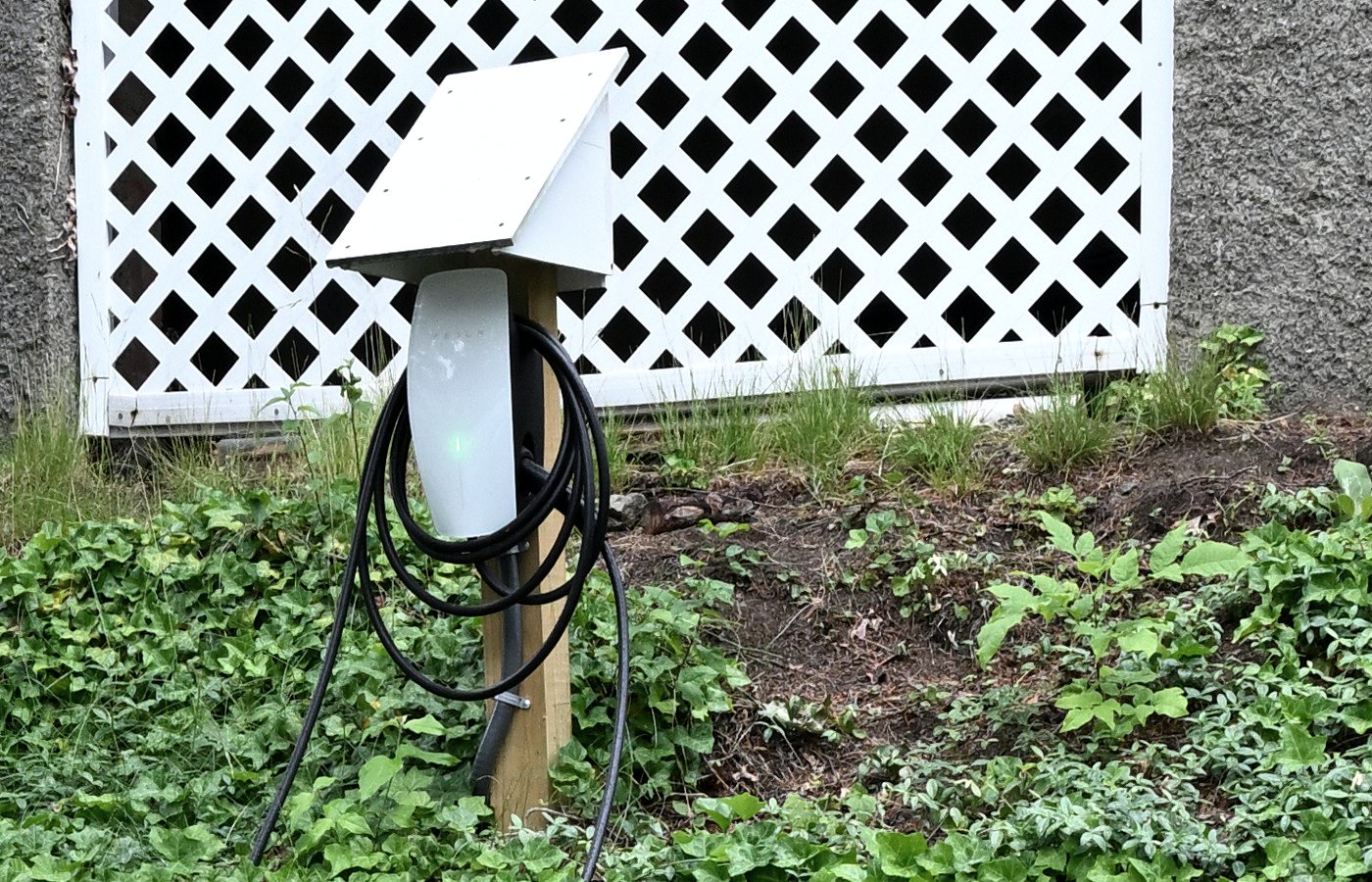
- Wall connector — the unit itself — a catalogue price that barely moves between quotes
- Mount — where it lands. The distance from the panel out to this point is what moves the bill
Run your own numbers in the electrical panel calculator →
Quotes for the same Level 2 charger install can come back at $600 or at $4,000, and both can be honest. The difference is never the charger — it's the electrical path between your panel and the parking spot. Here is the full cost picture for 2026, itemized the way an electrician builds the quote: the unit, the circuit, the panel question, and the permit. Most homeowners land at $800–$2,200 all-in without panel work, and $1,500–$3,500 when a panel upgrade rides along.
What a Level 2 installation actually includes
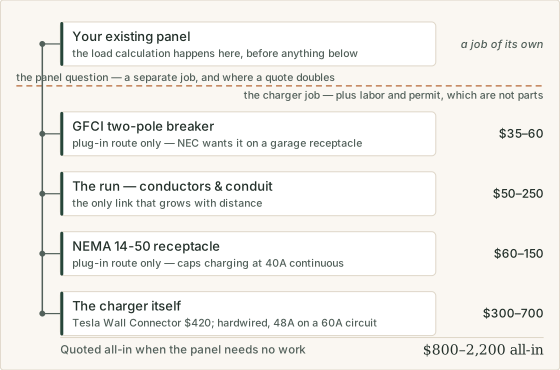
A Level 2 charger is, electrically, a big 240V appliance on its own dedicated circuit — the same species of work as wiring a range. Every quote has four layers:
- The charger unit: $300–$700 for the popular wall-mounted models (2026 retail). Some automakers bundle one with the car; the Tesla Wall Connector is $420.
- A dedicated 240V circuit: a two-pole breaker, copper conductors sized to the charger's amperage (typically 40–60A), and conduit or staples to the mounting point. Materials commonly run $50–$250 for a short run.
- Electrician labor: billed at $60–$150 per hour in 2026. That billed rate sits well above the trade's raw wage because it also carries burden, overhead, truck, insurance, and profit; the wage benchmark behind it is in the sources at the foot of this page. A near-panel garage install is a half day; a finished-basement fish job or exterior run is not.
- Permit and inspection: $75–$400. A new 240V circuit requires one nearly everywhere in the U.S. If a bid says "no permit needed," get a different bid.
Put together, industry cost guides in 2026 put the total for a typical install at $800–$2,200 including the unit, and installers who quote fully code-compliant work tell customers to budget $1,500–$2,500. Those two ranges agree once you notice the second one assumes a mid-priced hardwired unit and a permit in a mid-cost city.
Cost to install a 240V outlet in a garage (the NEMA 14-50 route)
If your charger is plug-in rather than hardwired, what you are really buying is a NEMA 14-50 outlet on a new 50A circuit: $340–$1,150 installed. That band breaks down into three lines:
- EV-rated receptacle: $60–$150
- Electrician labor: $150–$600
- Circuit materials: $50–$250
Do not economize on the first line. The $10 big-box special is not rated for the continuous draw of daily charging, and this is the one place cheap hardware causes melted plastic. When the garage wall backs onto the panel, real quotes cluster at just $300–$600.
Two code notes worth knowing before the electrician arrives. First, recent National Electrical Code editions require GFCI protection for garage receptacles like the 14-50, which means a specialty two-pole breaker instead of a standard one; those specialty breakers list at $35–$60 and up. Second, a plug-in charger is limited to 40A of continuous charging, while hardwired units can go to 48A on a 60A circuit. Hardwiring costs a little more in labor, drops the receptacle from the parts list, and gets you faster charging with fewer connection points.
Tesla Wall Connector: a worked example
The Wall Connector is a useful benchmark because the hardware price is fixed and public: $420, down from $475 after Tesla cut it in late 2024. It hardwires to a circuit of up to 60A, so a typical install is the unit + a 60A two-pole breaker + a short conduit run + a half day of labor. Installed totals in 2026 guides land at $750–$2,000. The low end is a garage wall a few feet from a 200A panel with open breaker slots; the high end is a 40-foot run across a finished ceiling, or a panel that needed a load-management device to make room. If a Wall Connector quote comes in well above $2,000, the extra money is in the panel or the run — ask for the line items, and check them against our electrical panel cost calculator.
When the panel upgrade rides along — and what it adds
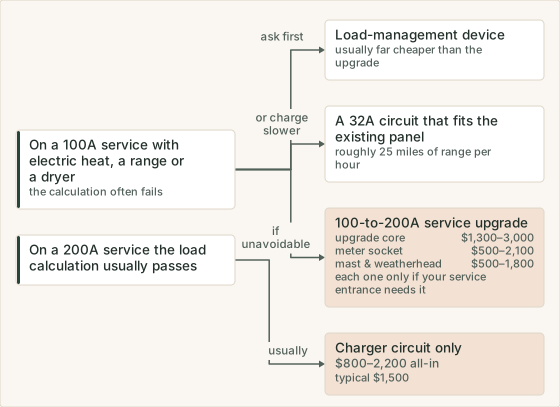
A 48A charger draws more continuous current than anything else in most houses, so the electrician starts with a load calculation. On a 200A service, the answer is usually "you're fine." On a 100A service with electric heat, an electric range, or a dryer, the calculation often fails — and then the honest quote includes a 100-to-200 amp service upgrade at $1,300–$3,000 for the core. If your service entrance needs work too, three more lines price on top of that core:
- Meter socket: $500–$2,100
- Mast: $500–$1,800
- Utility coordination: $0–$500
Industry figures for the full EV-charger-plus-panel-upgrade package run $1,500–$3,500, with complex jobs exceeding $3,500.
Before accepting that number, ask about a load-management device: a small controller that pauses or throttles charging when the rest of the house is drawing hard. It lets many 100A homes add a Level 2 circuit without touching the service, and it is usually far cheaper than the upgrade. It is also worth asking whether a slightly slower charger solves the problem — a 32A circuit that fits your existing panel still adds roughly 25 miles of range per hour, which covers almost any overnight need. If the upgrade really is unavoidable, price it line by line in the panel upgrade estimator — it shows exactly why the utility-side work, not the panel box, is what you are paying for. One more 2026 reality: the producer price index for panelboards and switchgear rose 12.4% in the year through May 2026, so panel quotes from older cost articles will read low.
Long runs, detached garages, and outdoor mounts
Distance is the quiet budget-killer. Once the charger is 40–80 feet from the panel — a detached garage, a carport on the far side of the house — the electrical work alone runs $800–$2,000 for trenching, conduit, and heavier conductors, before the charger. For a detached garage you will often be quoted a 60A or 100A subpanel in the garage instead of a single long charger circuit; that typically prices at $1,000–$3,000 all-in and leaves capacity for lights, openers, and tools. The buried feeder is the swing item at roughly $8–$19 per foot — the calculator's subpanel mode lets you enter your actual distance.
The federal tax credit is gone — check local rebates instead
Through mid-2026, the federal Section 30C credit refunded 30% of charger hardware and installation, capped at $1,000. That credit ended for equipment placed in service after June 30, 2026 under the 2025 budget law, and as of this writing it is not available regardless of what older articles say. What remains is patchwork but real: many electric utilities and several states offer rebates in the $200–$500 class for Level 2 hardware, wiring upgrades, or off-peak charging enrollment. Search your utility's name plus "EV charger rebate" before you buy the unit — some programs require pre-approval or a specific charger model, and a five-minute check can cover the permit fee several times over.
How to read your quotes
Get three bids and make each one itemize: charger unit (or "customer-supplied"), circuit amperage, wire size and run length, panel work if any, permit, and total labor hours. A bid that is $800 above the others almost always differs on one visible line — usually the panel or the run — and now you know the market band for each. That single comparison, not haggling, is where homeowners save real money on this job. Our numbers, sources, and pull dates are documented on the methodology page, and the pricing dataset behind the electrical figures here is the same one that powers the panel calculator.
Frequently asked questions
How much does it cost to install a Level 2 EV charger at home in 2026?
Most straightforward installs — panel has capacity, charger lands in a garage near the panel — run $800–$2,200 all-in, including a $300–$700 charger unit. A safe planning budget for a fully code-compliant install with permit is $1,500–$2,500. Long wire runs, outdoor mounting, or panel work push past that.
How much does EV charger installation cost with a panel upgrade?
Budget $1,500–$3,500 all-in when a 100A panel needs a 200A service upgrade alongside the charger circuit, and expect complex jobs — long service-entrance work, exterior disconnect requirements — to exceed $3,500. The panel upgrade core alone is $1,300–$3,000 before meter socket, mast, or utility coordination.
What does it cost to install a 240V outlet in a garage for an EV charger?
A NEMA 14-50 outlet on a new dedicated circuit runs $340–$1,150: $60–$150 for an EV-rated receptacle, $150–$600 of electrician labor, and $50–$250 in breaker, wire, and conduit. If the garage wall is close to the panel, quotes cluster at $300–$600.
How much does Tesla Wall Connector installation cost?
The unit is $420 from Tesla, and installed totals typically land at $750–$2,000 depending on the circuit size (up to 60A), the run length, and local labor. It is hardwired, so unlike a plug-in charger you cannot reuse an existing range or dryer outlet.
Is there still a federal tax credit for home EV charger installation?
No. The Section 30C credit — 30% of hardware and installation up to $1,000 — was terminated for property placed in service after June 30, 2026. Check your electric utility and state instead; many still offer $200–$500-class rebates that change year to year.
Data sources
Charger and outlet bands: HomeGuide, Recharged, The Power Pick, and InstaElectricians, published 2025–2026. Electrical labor and panel bands: BLS OEWS and the contractor guides documented in our dataset. Labor wage benchmark: BLS May 2025 median of $30.38/hr for electricians, occupation 47-2111. Figures are planning ranges, not quotes or electrical advice — EV circuits are licensed work everywhere in the U.S.