Heat pump installation cost — and when switching from gas or oil pays off (2026)
Last reviewed 2026-07-28 · pricing data as of 2026-07 · how we build these numbers
Run your own numbers in the HVAC system calculator →
Heat pumps get sold with a slogan — "heat and cool with one machine, save money doing it" — and the first half is simply true. The second half depends entirely on what you heat with today and what you pay for electricity, and most heat pump marketing avoids that math. This guide does the opposite: real installed-cost bands built from published equipment prices, then the operating math in dollars per million BTU so you can see exactly when switching pays and when it does not.
What a heat pump costs installed in 2026
Start with a number you can verify: a Goodman 3-ton 14.3 SEER2 heat-pump condenser (GLZS4BA3610) listed at $3,814, on sale at $3,051, at HVACDirect.com when we pulled prices in July 2026. That is the same distributor-retail baseline we use in our AC replacement calculator, where the comparable straight-cooling condenser lists at $2,276 — so the heat-pump hardware itself carries roughly a $1,200–1,500 premium at this tier for the reversing valve, defrost controls, and cold-side engineering.
From there the installed math follows the same recipe we disclose everywhere on this site: equipment at distributor retail × a 1.2–1.6 contractor markup (procurement, warranty, overhead), plus labor at the $75–150/hour billed rates published in 2026 HomeGuide and Angi cost guides. Two scopes cover most projects:
- Change-out (condenser + matched coil), reusing your air handler or pairing with your existing furnace as dual fuel: roughly $5,300–10,000 installed, typically around $8,100 for 3 tons.
- Full split system including a new air handler — the usual scope when an oil or electric furnace is being retired: roughly $7,500–14,600 installed, typically around $11,300 for 3 tons.
Add the small stuff quotes love to bury:
- New lineset: $200–750
- Electrical disconnect and breaker work: $200–600
- Pad: $100–400
Equipment prices are still drifting upward — the BLS producer price index for AC and warm-air heating equipment rose 3.2% in the year through May 2026 — so a quote that sits six months is a quote that expires. Size the system before you price it: our HVAC sizing calculator brackets your tonnage from square footage and climate, as a budget-planning step before your contractor's Manual J.
The operating math: dollars per million BTU
Every heating fuel can be put on one scale — the cost to deliver one million BTU (MMBtu) of heat into your rooms. Start from the winter 2025–26 national average prices published by the EIA:
| Fuel | U.S. residential average | Period averaged |
|---|---|---|
| Natural gas | $15.63 per thousand cubic feet | October–March |
| Heating oil | $4.06 per gallon | October–February |
| Electricity | 18.83¢/kWh | April 2026 |
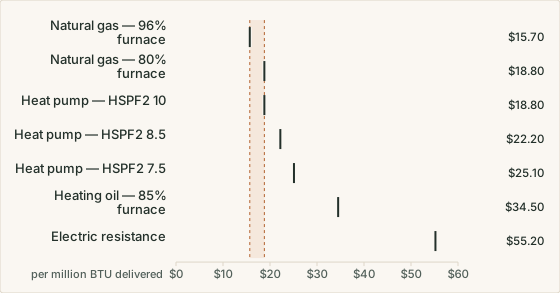
Run those prices through each machine's efficiency and the delivered cost of heat comes out like this:
- Natural gas, 96% furnace: about $15.70 per MMBtu ($18.80 through an older 80% furnace)
- Heat pump, HSPF2 8.5: about $22.20 per MMBtu ($25.10 at the 7.5 federal-minimum rating; $18.80 at a high-end 10)
- Heating oil, 85% furnace: about $34.50 per MMBtu
- Electric resistance (baseboard or electric furnace): about $55.20 per MMBtu
Read that list plainly and the marketing fog lifts. Against a working natural gas furnace at national-average prices, a typical heat pump costs more to run, not less. Against oil it cuts the bill by roughly a third; against electric resistance it cuts it by more than half. The crossover with gas arrives when your electric rate falls to roughly 13¢/kWh at these gas prices — which is why heat pumps pencil out beautifully in the hydro-powered Pacific Northwest and poorly in New England, where electricity runs 25–30¢ even though winters are cold.
What that means in dollars per year
Scale it with real run hours. The EPA/ENERGY STAR full-load-hours dataset — the same one behind our sizing calculator — puts a New York-area heating season at 2,337 full-load hours; on a 3-ton (36,000 BTU/h) system that is about 84 MMBtu of delivered heat a year. At the rates above, that season costs roughly $1,320 on gas (96% furnace), $1,860 on a heat pump (HSPF2 8.5), $2,900 on oil, and $4,640 on electric resistance. Atlanta's shorter 1,686-hour season scales everything down by about 28%; Minneapolis's 2,496 hours scales it up — with the cold-climate caveat that below the balance point a heat pump leans on backup heat and its effective efficiency drops, so treat the heat-pump line as its most favorable case in severe climates.
Cost to convert an oil furnace to a heat pump
Oil is where conversion math gets easy. Budget the full-split scope — $7,500–14,600 installed, typically about $11,300 — plus $200–600 of electrical work for the circuit and disconnect, and whatever oil-tank decommissioning your state requires, which is regulated locally and worth pricing before you commit. A panel upgrade, if your load calculation demands one, is its own project on top. The return: at $4.06/gallon oil versus average electric rates, the ~84 MMBtu New York-scale season above saves about $1,040 a year; Minneapolis-scale loads save around $1,100, Atlanta-scale around $750. Simple payback lands near 7–15 years on fuel alone — and meaningfully faster if your AC was due for replacement anyway, since the heat pump replaces that spend too, or if your state or utility still pays electrification rebates. One honest warning: the federal 25C credit that paid up to $2,000 toward qualifying heat pumps ended for equipment placed in service after December 31, 2025, so 2026 budgets should not count on it.
When switching from gas pays off — and when it doesn't
Four situations flip the gas math in the heat pump's favor. First, cheap electricity: below about 13¢/kWh, the heat pump beats even a 96% gas furnace on running cost. Second, high gas fixed charges: if dropping the gas meter saves a $20–40 monthly customer charge, that is $240–480 a year no per-MMBtu comparison captures. Third, your AC is dying anyway: a heat pump costs only modestly more than the equivalent AC, so the marginal cost of gaining heating capability is small — run both options through our HVAC system replacement calculator and the AC replacement calculator to see the gap in your size. Fourth, dual fuel: keeping the gas furnace for the coldest weeks while the heat pump handles the shoulder seasons lets each machine run where it is cheapest, and it is the configuration most cold-climate contractors quote first.
And the honest converse: if you have a functioning gas furnace, average-or-high electric rates, and no AC replacement on the horizon, ripping it out for a heat pump is a values decision or a comfort decision — both legitimate — but not a money decision. The math above is the same math your contractor should be able to walk you through with your own utility rates; if a bidder cannot, that tells you something about the rest of the proposal.
Frequently asked questions
How much does a heat pump cost installed in 2026?
A ducted heat-pump change-out that reuses your existing air handler or pairs with your furnace (dual fuel) runs roughly $5,300–10,000 installed, typically around $8,100 for a 3-ton system. A full split system including a new air handler — the usual scope when leaving an oil furnace — runs roughly $7,500–14,600, typically around $11,300. Those bands are built from a published $3,051–3,814 Goodman 3-ton heat-pump condenser price, a matched coil, a disclosed 1.2–1.6x contractor equipment markup, and labor at $75–150 per hour.
Is a heat pump cheaper to run than a natural gas furnace?
At national-average prices, usually not. Winter 2025–26 residential gas averaged $15.63 per thousand cubic feet, which works out to about $15.70 per million BTU of delivered heat through a 96% furnace, while a heat pump at HSPF2 8.5 and the 18.83¢/kWh average electric rate delivers the same heat for about $22.20. The heat pump wins where electricity is cheap relative to gas (roughly 13¢/kWh or less at those gas prices), where gas carries high fixed monthly charges, or when the alternative is oil, propane, or electric resistance heat.
How much does it cost to convert an oil furnace to a heat pump?
Budget the full-split scope — roughly $7,500–14,600 installed, typically around $11,300 for 3 tons — plus electrical work ($200–600 for a circuit and disconnect, more if your panel needs upgrading) and any oil-tank decommissioning your state requires. Against winter 2025–26 heating oil at $4.06 per gallon, a heat pump at average electric rates cuts heating cost by roughly a third, about $750–1,100 a year for a typical Northeast or Midwest heat load, putting simple payback around 7–15 years before any state or utility rebates.
Do heat pumps work in cold climates?
Modern cold-climate models hold usable capacity well below 0°F, but two honest caveats apply: capacity and efficiency both fall as temperature drops, and below the balance point a backup heat source carries part of the load — electric-resistance backup at roughly triple the heat pump's running cost per BTU. That is why dual-fuel setups, which keep a gas furnace for the coldest weeks, are a common configuration in cold climates rather than a compromise.
Is there still a federal tax credit for heat pumps in 2026?
No. The federal 25C Energy Efficient Home Improvement Credit, which paid up to $2,000 toward qualifying heat pumps, ended for equipment placed in service after December 31, 2025 under the 2025 tax law. State and utility programs still exist and can be worth $1,000–8,000 or more depending on where you live and your income — check your state energy office and your utility before signing anything.
Sources and dates
Equipment: HVACDirect.com published Goodman prices, retrieved 2026-07 (GLZS4BA3610 heat pump $3,051 sale / $3,814 list; GLXS4BA3610 AC $2,276 list). Fuel prices: EIA Natural Gas Monthly, U.S. residential average, Oct 2025–Mar 2026 ($15.63/Mcf winter average); EIA No. 2 heating oil residential monthly, Oct 2025–Feb 2026 ($4.06/gal average); EIA Electric Power Monthly Table 5.6.A, April 2026 (18.83¢/kWh). Heating full-load hours: EPA 2002 dataset via the ENERGY STAR ASHP Savings Calculator assumptions sheet. Labor rates: HomeGuide/Angi 2026 guides ($75–150/hr billed); wage context BLS OES 49-9021 (May 2025). Equipment trend: BLS PPI PCU333415333415, +3.2% YoY through May 2026. Conversion constants: 1.038 MMBtu/Mcf gas, 138,500 BTU/gal oil, 3,412 BTU/kWh.