AC unit replacement cost calculator
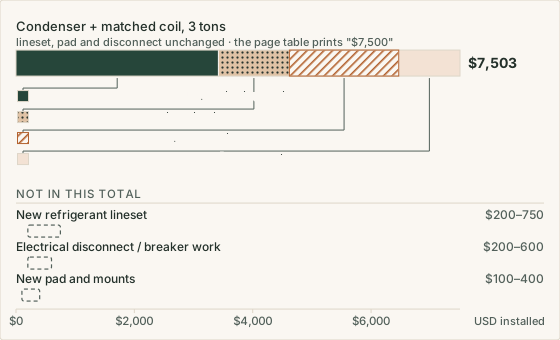
Replacing a 3-ton central AC unit — condenser plus matched indoor coil — runs about $4,400 to $9,400 installed in 2026, and most jobs land between $5,900 and $7,500 at base-to-mid efficiency (SEER2 14.3–15.2). The spread comes down to three things: the SEER2 tier you pick, what HVAC labor bills in your area, and add-ons such as a condenser pad or a disconnect swap. Figures derive from published distributor list prices and cost guides; BLS wage data is shown for regional context.
Pick your system size, efficiency tier, and how much of the system is being replaced. You get an itemized low / typical / high installed cost — equipment, labor, and add-ons on separate lines, with the markup we applied stated out loud.
Last reviewed 2026-07-22 · pricing data as of 2026-07 · how we build these numbers
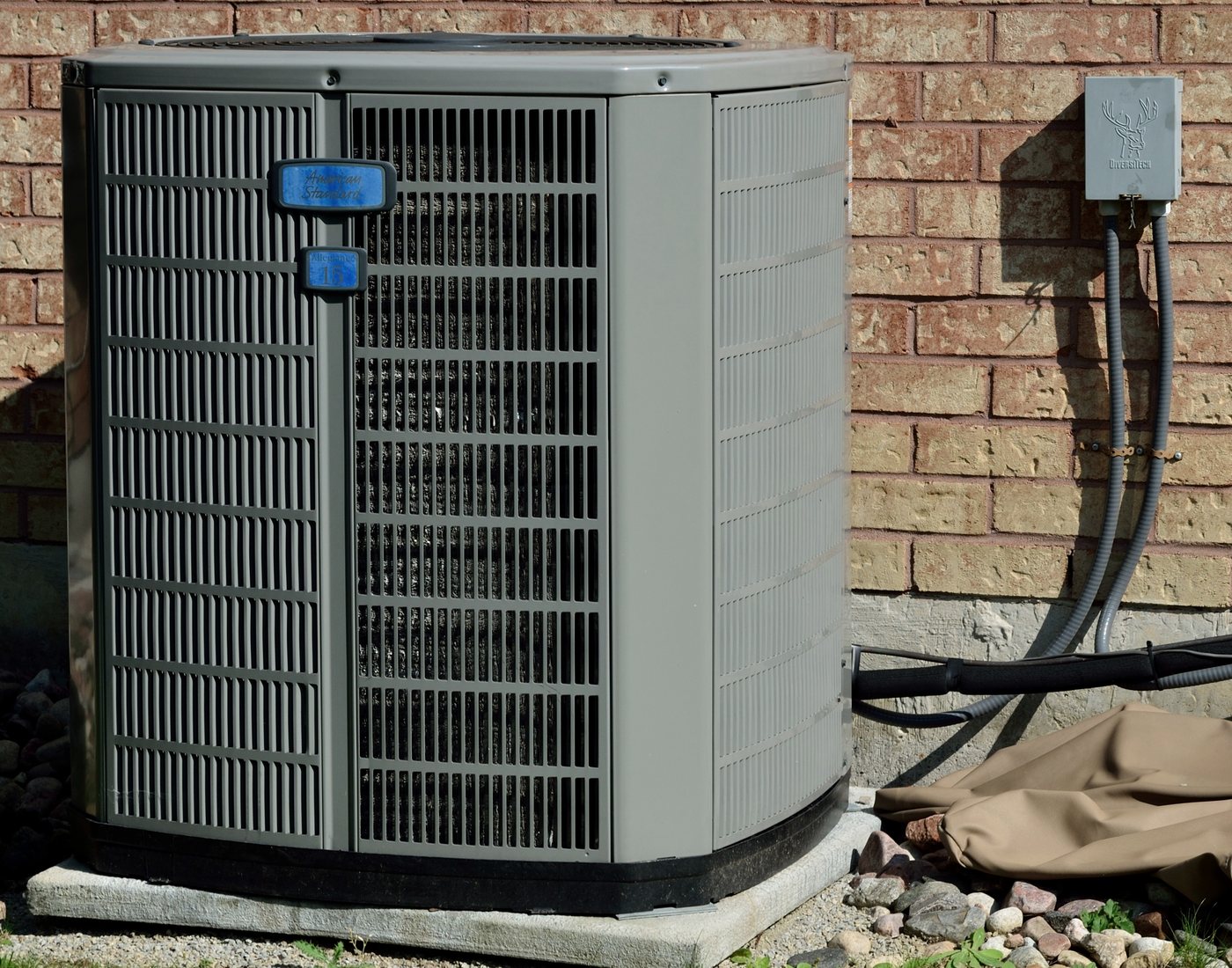
- Condenser — the outdoor half of a split system — condenser plus matched indoor coil is the base of every bid
- Pad — what the unit stands on. A new pad with mounts is a $100–$400 add-on, and bids differ on whether it is in
- Disconnect — the switch that has to sit within sight of the unit — bringing it to current code runs $200–$600
- Lineset — the insulated refrigerant run back to the indoor coil. A new one is $200–$750 and the commonest late discovery
How this estimate is built
The calculator does exactly four things, in the open:
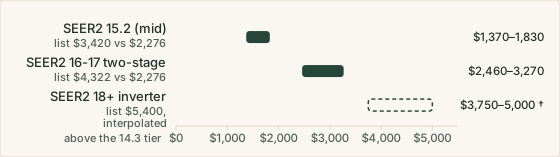
- Equipment list price. Each tonnage × SEER2 tier carries a published distributor list price for the outdoor condenser, taken from the Goodman GLXS/GLXT R-32 class. At 3 tons those anchors are $2,276 for SEER2 14.3, $3,420 for the 15.2 mid tier, and $4,322 for the 17.2 two-stage. Every cell is on the same list-price basis, so tier step-ups compare like for like. Promotional sale prices behave like the low anchor: we observed those same units about 20% below list during a July-4th event. If your scope includes the matched evaporator coil ($900–1,500) or an air handler ($1,500–2,300), those are added at this step. Prices we couldn't verify verbatim are interpolated from the verified tonnage curve and flagged in the dataset.
- Contractor markup. Installed quotes price equipment above distributor list — procurement, warranty handling, overhead, and profit. We multiply by 1.2 (low) / 1.4 (typical) / 1.6 (high) and say so, because this multiplier is the single number most cost calculators hide.
- Labor. Each scope carries a labor band from published 2026 guides: $400–1,000 for a condenser swap (4–8 crew-hours), $600–1,500 with a coil (6–12 hours), $1,000–2,400 for a full split system (10–16 hours). The typical value is the $115/hr midpoint billed rate times the midpoint hours. Billed rates of $75–150/hr sit well above the BLS median technician wage of $29.33/hr — the difference is overhead, insurance, the truck, and margin.
- Add-ons. A new lineset ($200–750), disconnect or breaker work ($200–600), and a new pad with mounts ($100–400) are added only if you check them.
Data sources
Equipment: HVACDirect.com published list prices, Goodman GLXS/GLXT R-32 series, retrieved July 2026. Labor: BLS Occupational Employment and Wage Statistics, occupation 49-9021 (HVAC mechanics and installers), May 2025 national median wage $29.33/hr, series OEUN000000000000049902108, plus HomeGuide/Angi 2026 billed-rate guides ($75–150/hr). Price trend: BLS Producer Price Index series PCU333415333415 (air-conditioning equipment manufacturing), May 2026, up 3.2% year over year. Pricing data as of 2026-07. See methodology for the full trail.
Why the default is 3 tons
Residential central air runs on a rough rule of one ton of cooling capacity per 400–600 sq ft, depending on climate and insulation. The median U.S. single-family home is about 1,700–2,000 sq ft, which lands at 2.5–3.5 tons — so 3 tons is the statistical center of the replacement market, not a recommendation for your house. If you're replacing anyway, capacity is worth checking rather than copying: an oversized unit short-cycles and dehumidifies poorly. Our HVAC sizing estimator shows the capacity math by climate and insulation, and a contractor's ACCA Manual J calculation is the real answer.
Typical installed cost by tonnage
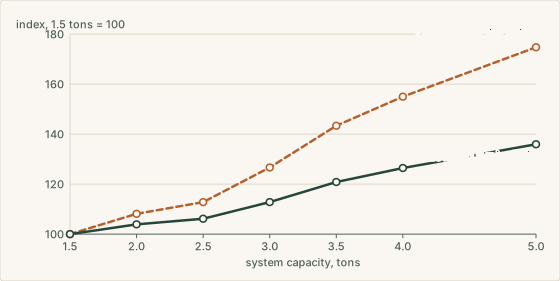
All figures below are computed from the same bands the calculator uses — condenser plus matched coil, national-average labor, no add-ons, rounded to the nearest $100. The planning band runs from the low band at base efficiency to the high band at mid efficiency.
| Capacity | Typical — SEER2 14.3 (base) | Typical — SEER2 15.2 (mid) | Full planning band |
|---|---|---|---|
| 1.5 tons | $5,200 | $6,500 | $3,800–$8,200 |
| 2 tons | $5,400 | $6,800 | $4,000–$8,600 |
| 2.5 tons | $5,600 | $7,000 | $4,100–$8,800 |
| 3 tons | $5,900 | $7,500 | $4,400–$9,400 |
| 3.5 tons | $6,300 | $8,100 | $4,800–$10,100 |
| 4 tons | $6,600 | $8,600 | $5,000–$10,600 |
| 5 tons | $7,100 | $9,300 | $5,400–$11,500 |
Notice how flat the curve is: doubling capacity from 2.5 to 5 tons raises the typical bill by only about 30%, because labor, the coil, and the markup structure don't scale with tonnage. That's why "price per ton" is a misleading way to compare bids.
What can move your real price outside this range
- Regional labor — the BLS wage data behind our labor band varies from about 20% below the national median (Gulf South, parts of Appalachia) to 25% or more above it (California, the Northeast corridor, Washington state). Coastal-metro bids commonly land near or above our high band on labor alone.
- Access — an air handler in a tight attic or crawl space can push coil labor from 2–4 hours to 5–10 hours; published guides bill that directly.
- Refrigerant transition — 2025–2026 is the R-410A to R-32/R-454B changeover (R-32 for Daikin/Goodman/Amana and most ductless brands; R-454B for Carrier, Trane, Lennox, Rheem, and York). New-refrigerant equipment carried a manufacturing price index increase of 3.2% in the year to May 2026, R-454B cylinder shortages squeezed some 2025 installs, and old-refrigerant coils generally can't be reused, which pushes condenser-only jobs into condenser-plus-coil scope.
- Brand tier — our list-price anchors are Goodman, a value-tier brand. Premium nameplates (Carrier, Trane, Lennox) list meaningfully higher for the same tonnage and SEER2 tier, so read a premium-equipment bid against the middle-to-high end of these bands rather than the typical line.
- Ductwork condition — leaky or undersized ducts aren't in this estimate at all. Sealing runs $1,000–6,000 depending on home size and method, and whole-home duct replacement adds $2,100–4,000 on a typical 2,000 sq ft house when bundled into a system job; our ductwork replacement cost guide breaks that down per square foot and per duct run.
- Permit and code items — some jurisdictions require a permit ($50–300), a code-current disconnect, or a condensate safety switch on replacement; good bids list these, cheap bids omit them and change-order later.
Reading your bids against this estimate
The itemized lines are the point of this tool. When a bid comes in $2,000 above our typical band, the useful question isn't "why so much?" — it's "which line?" If the equipment line is high, ask for the model number and look up its list price the way we did. If labor is high, ask for the expected crew-hours; a one-day, two-tech job at coastal rates legitimately reaches $2,000–2,400, but the same number on a four-hour condenser swap deserves an explanation. If the bid folds everything into one number, ask for the split — a contractor who won't itemize equipment versus labor is asking you to negotiate blindfolded.
Also check what the bid doesn't include. The three add-ons in this calculator — lineset, electrical, pad — are the most common late "discoveries." A bid that names them up front, even at the high end of our bands, is usually the more honest total than a lean bid that finds them mid-job.
If your furnace or air handler is also near end of life, price the combined job before committing: a full system change-out shares one mobilization, one crew day, and one refrigerant charge, and the equipment arrives warranty-matched — where separate projects each carry their own call-out and setup, and an aging survivor often fails within a few years anyway. Our full HVAC system calculator prices that scenario with the same disclosed method, so you can compare both totals side by side.
Frequently asked questions
How much does it cost to replace a 3-ton AC unit?
About $5,900 to $7,500 typical installed for a 3-ton condenser plus matched coil at base-to-mid efficiency (SEER2 14.3–15.2), inside a full planning band of roughly $4,400 to $9,400. Equipment tier, your local labor market, and add-ons like a new lineset or electrical work decide where you land inside that band.
Why are installed quotes so much higher than the condenser prices I see online?
Contractors price equipment at roughly 1.2 to 1.6 times distributor list to cover procurement, warranty handling, overhead, and profit, then add $400 to $2,400 of labor depending on scope. We apply that markup in the open: a $3,420 list condenser reasonably becomes $4,100 to $5,500 on a quote before labor is added.
Do I have to replace the indoor evaporator coil with the condenser?
Usually yes. New condensers run one of the two A2L refrigerants that replaced R-410A in 2025 — R-32 (Daikin and its Goodman/Amana brands, plus most ductless makers) or R-454B (Carrier, Trane, Lennox, Rheem, York) — and an R-410A-era coil is not compatible with either, nor correctly matched; a mismatched coil can void the warranty and cut rated efficiency. Budget the condenser-plus-coil scope unless your coil is only a few years old and confirmed compatible by the installer in writing.
How much more does a higher SEER2 tier cost to install?
On a 3-ton system, stepping from base SEER2 14.3 to 15.2 adds roughly $1,370 to $1,830 installed; to a 16-17 two-stage unit roughly $2,460 to $3,270; to an 18+ inverter unit roughly $3,750 to $5,000 — condenser list-price deltas times the disclosed 1.2–1.6x markup. Whether the step-up pays back depends on your climate and electric rate, not the sticker alone.
Can I use this calculator to estimate central air conditioning installation cost?
Yes, for the most common case: replacing or installing a central air conditioning split system where usable ductwork already exists. The condenser, matched coil, labor, and add-on bands above are exactly that job. What it does not price is adding central air to a house with no ducts — duct installation is its own project; for scale, even replacing existing ducts runs $2,100–4,000 on a typical 2,000 sq ft home when bundled into a system job. Our ductwork replacement cost guide covers those numbers.
Is this a quote?
No. It is a planning range built from published distributor prices and labor data, meant to tell you whether a real bid is in reasonable territory. Get at least three written quotes and ask each bidder to itemize equipment, labor, and add-ons the way this page does.