Roof replacement cost calculator
Tearing off and replacing the roof on a 1,500 sq ft single-story house runs about $12,200–$22,000 with architectural shingles in 2026, typical near $16,200 — that is about 20.4 squares of roof once standard eave overhangs are counted (22.5 squares of shingle with waste) at $450–$750 installed per square plus $100–$250 per square of removal. Material moves the number most (3-tab starts near $400 per square; standing-seam metal runs $1,000–$2,300), with roof pitch and state labor rates close behind.
Enter your home's footprint, roof pitch, and material. You get a low / typical / high installed-cost range — and the worksheet we used to get there, so you can challenge any assumption.
Already holding a bid? Check its line items against these bands → — paste them and each one is converted to a rate per square and placed above, inside, or below what we publish. It runs in your browser; the quote is never uploaded.
Last reviewed 2026-07-28 · pricing data as of 2026-07 · how we build these numbers
How this estimate is built
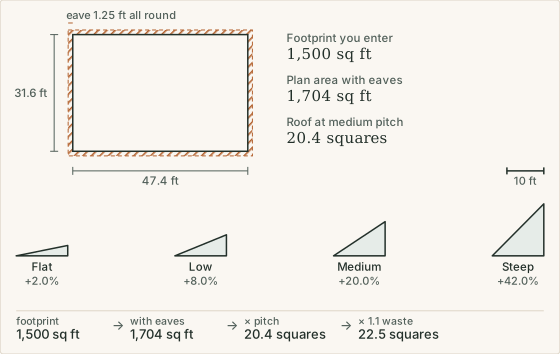
The calculator does exactly four things, in the open:
- Roof area. Your footprint is first widened for the overhang — the roof edge extends past the walls on nearly every house, typically 12–24 inches at the eaves and 6–12 at the rakes, so the default adds about 15 inches on all four sides. That is roughly 14% more area on a 1,500 sq ft footprint; estimates that skip this step undercount every roof with eaves. The widened plan area is then multiplied by a pitch factor (1.02 for flat up to 1.42 for steep) to approximate the true sloped surface, and divided by 100 to get roofing "squares" — the unit contractors actually price in.
- Waste factor. Squares are increased 10% for cut-offs, ridge caps, and starter strips. Complex roofs with many valleys can run higher; simple gable roofs a bit lower.
- Material rate. Each material carries a low / typical / high installed cost per square — labor, underlayment, flashing, permit, and disposal included — from the sources listed below.
- Tear-off. If the old roof comes off, removal and dump fees are added per square of actual roof area.
Data sources
Pricing data: BLS Occupational Employment and Wage Statistics, occupation 47-2181 Roofers (May 2025 national median $26.65/hr); shingle shelf pricing from Home Depot and Lowe's listings dated Feb–Jun 2026; and 2026 contractor cost guides (This Old House, Homewyse, HomeGuide, Angi) for installed cost per square. See methodology for the full trail and pull dates.
Installed cost per square, by material
These are the same bands the calculator prices with — per square of roof surface, labor and disposal included, before tear-off:
| Material | Per square (100 sq ft) | Per sq ft |
|---|---|---|
| Asphalt shingles — 3-tab | $400–$650 | $4.00–$6.50 |
| Asphalt shingles — architectural | $450–$750 | $4.50–$7.50 |
| Cedar shake | $750–$1,600 | $7.50–$16.00 |
| Metal — standing seam | $1,000–$2,300 | $10.00–$23.00 |
| Clay tile | $1,100–$2,600 | $11.00–$26.00 |
The bare-material share is smaller than most people assume. An architectural shingle bundle sold for about $43 at Home Depot in June 2026, and three bundles cover one square — roughly $130 of shingle per installed square that costs $450–750. The other $320–620 is underlayment, ice-and-water shield, flashing, fasteners, labor, permits, disposal, and the contractor's overhead and margin. On that labor line, BLS puts the median roofer wage at $26.65/hr; crews bill far above wage. That gap is normal — but it is also where quotes diverge, which is why the itemized lines matter more than the bottom line.
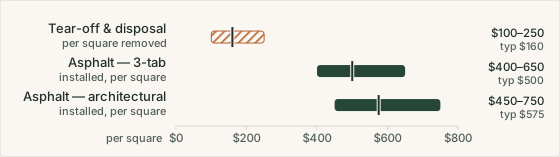
Asphalt shingle cost per square (3-tab vs architectural)
Most re-roofs come down to one decision: which asphalt shingle. Here is the same per-square math split three ways — the bare shingle you could buy off the shelf, everything else the installed price carries, and the installed total the calculator prices with:
| Shingle type | Shingle material per square | Labor + other layers per square | Installed per square |
|---|---|---|---|
| 3-tab | $75–$120 | $300–$550 | $400–$650 |
| Architectural laminate | $105–$130 | $320–$620 | $450–$750 |
| Premium / designer laminate | $200–$350 | $400–$700 | $650–$1,000 |
Each column is its own low/high band, so the first two don't sum row-by-row to the third — a low-material job rarely lands with low-everything-else labor. The shelf anchor: three bundles cover a square, and architectural bundles ran about $43 at Home Depot in June 2026 (about $130 per square of bare shingle), with 3-tab bundles at $25–40. The upgrade from 3-tab to architectural costs roughly $50–100 more per square installed and typically buys a thicker, longer-warranted shingle; 2026 contractor guides consistently put the installed gap at about $0.70–1.00 per sq ft. Premium and designer laminates aren't in the calculator's dropdown — if that's your pick, run the estimate on architectural and read the result at or above the high band.
Worked examples at common sizes
Three scenarios, computed with the exact formula above — architectural shingles, standard eave overhangs, single-layer tear-off included, national-average pricing. Run your own numbers in the form to adjust pitch, overhang, or material.
| Scenario | Roof math | Low / typical / high |
|---|---|---|
| 1,500 sq ft ranch, medium pitch | 1,500 + eaves ≈ 1,704 plan × 1.2 = 20.4 squares (22.5 with waste) | $12,200 / $16,200 / $22,000 |
| 1,800 sq ft footprint, medium pitch | 1,800 + eaves ≈ 2,023 plan × 1.2 = 24.3 squares (26.7 with waste) | $14,400 / $19,200 / $26,100 |
| 22-square roof, already measured | 2,200 sq ft of surface — overhangs already inside a measured area (24.2 with waste) | $13,100 / $17,400 / $23,700 |
Reading the first row out loud: 22.49 effective squares × $575 typical = $12,933 of installed architectural shingle, plus 20.45 squares × $160 = $3,271 of tear-off and disposal, is $16,204 — which we round to $16,200. Every row works the same way; nothing is hidden in an "adjustment." If you've re-shingled before and remember a much smaller bill, that's not your memory failing: shingle and labor costs have risen steadily, and 2026 guide surveys put the national asphalt average near $5 per square foot of roof.
Roof replacement cost by state
Same house, different state, different bill — almost entirely because of labor. The table below re-prices the 1,500 sq ft medium-pitch ranch from the worked example for eighteen states. That scenario is architectural shingles, standard eaves, tear-off included, and its national band is $12,200 / $16,200 / $22,000:
| State | Roofer wage index | 1,500 sq ft ranch — low / typical / high |
|---|---|---|
| Arizona | 0.85 | $11,000 / $14,600 / $19,800 |
| California | 1.15 | $13,400 / $17,800 / $24,100 |
| Colorado | 0.93 | $11,600 / $15,500 / $21,000 |
| Florida * | 0.86 | $11,100 / $14,700 / $20,000 |
| Georgia | 0.85 | $11,000 / $14,600 / $19,800 |
| Illinois | 1.41 | $15,400 / $20,500 / $27,800 |
| Massachusetts | 1.31 | $14,600 / $19,500 / $26,400 |
| Michigan | 1.07 | $12,700 / $16,900 / $23,000 |
| Minnesota | 1.34 | $14,900 / $19,800 / $26,800 |
| New Jersey | 1.38 | $15,200 / $20,200 / $27,400 |
| New York | 1.19 | $13,700 / $18,200 / $24,700 |
| North Carolina | 0.88 | $11,200 / $14,900 / $20,300 |
| Ohio | 0.89 | $11,300 / $15,000 / $20,400 |
| Pennsylvania | 1.01 | $12,200 / $16,300 / $22,100 |
| Tennessee | 0.82 | $10,700 / $14,300 / $19,400 |
| Texas | 0.83 | $10,800 / $14,400 / $19,600 |
| Virginia | 0.87 | $11,100 / $14,800 / $20,100 |
| Washington | 1.09 | $12,900 / $17,200 / $23,300 |
How these numbers are made — no survey magic, one multiplication: each state's index is its BLS median roofer wage (OEWS May 2025, occupation 47-2181) divided by the national median of $26.65/hr, and we apply that index to the labor share only. Labor is roughly 65% of a roofing job, so the state multiplier is 0.35 + 0.65 × index — Illinois at 1.41 prices about 27% above the national band, Tennessee at 0.82 about 12% below. What this deliberately ignores: material freight, permit fees, and code differences (Hawaii's shipping premium, Florida's wind-code requirements), which is why full-cost surveys in 2026 contractor guides rank California and New York at the top while the wage index puts union-heavy Illinois, New Jersey, and Minnesota there. The direction agrees — South and Midwest below the national band, Northeast and West Coast above — but treat any state row as a starting band, not a local quote.
* Florida is where that limitation bites hardest, so its row carries a footnote: the 0.86 wage index prices Florida below the national band, but Florida Building Code wind provisions — a sealed roof deck or secondary water barrier, enhanced nailing schedules, roof-to-wall retrofit requirements, and HVHZ product approvals in Miami-Dade and Broward — add material and inspection scope no wage series can see, and 2026 full-cost surveys put actual Florida re-roof prices roughly 15–30% above the national average, not below it. Read the FL row as a labor-cost floor, not a market price. One honest limit on the whole column: OEWS medians count W-2 employee wages only, so in states where roofing runs heavily on 1099 subcontract crews the index understates what labor actually bills.
What can move your real price outside this range
- Roof complexity — hips, valleys, dormers, and skylights add labor and waste beyond the flat 10% factor.
- Regional labor — coastal metros commonly run 15–30% above the national typical band; rural markets below it. Rather than pretending zip-code precision, we publish a state wage index in the dataset: BLS series 47-2181, running from about 0.79 in Oklahoma to 1.41 in Illinois. Labor is roughly 65% of a roofing job, so a 1.20-index state prices about 13% above the national band, not 20%.
- Decking repairs — rotted sheathing is only discovered after tear-off and is billed per 4x8 sheet of plywood or OSB, commonly $75–150 installed per sheet (2026 contractor guides); prudent budgets hold 10% in reserve. Our cost-factors guide covers how that per-sheet price should appear in a bid.
- Multiple existing layers — removing two or three old layers costs more than the single-layer tear-off priced here.
Hip vs. gable: what roof shape does to the price
Two houses with the same footprint can carry meaningfully different roofing bills because of shape alone. A gable roof — two planes meeting at a single ridge — is the cheapest common shape to re-roof: long straight shingle courses, minimal cutting, and waste as low as 5%. A hip roof, sloped on all four sides, trades that one ridge for hip lines at every corner: each plane ends in diagonal cuts, each junction needs hip and ridge caps, and crews spend more hours on detail work. The result is a waste factor of 15% or more against a gable's 5–10%, and installed bids that commonly run 10–20% higher at the same square count.
The calculator's flat 10% waste factor is the midpoint between those shapes, and on the 1,500 sq ft ranch example above the difference is real money: pricing the same 20.4 squares at 5% gable waste gives a typical of about $15,600, while 15% hip waste gives about $16,800 — a $1,200 swing on shape alone, before the extra detail labor a hip commands enters a real bid. If your roof is a hip, or a cut-up hip-and-valley combination, read your result toward the high band and ask each bidder what waste percentage they carried. Our cost-factors guide ranks shape and complexity among the seven cost drivers.
Frequently asked questions
Why do you ask for footprint, not roof area?
Almost nobody knows their true sloped roof area, but county records and listing sites give the ground footprint. The overhang selector and pitch factor convert one to the other — and unlike sites that just guess, we show both factors we used so you can correct them.
How much does it cost to replace the roof on a 1,500 sq ft ranch house?
With architectural shingles on a medium-pitch ranch, plan around $16,200, inside a band of roughly $12,200 to $22,000 including tear-off. The math: 1,500 sq ft of footprint plus standard 15-inch eave overhangs ≈ 1,704 sq ft of plan area × 1.2 pitch factor ≈ 20.4 squares of roof; with 10% waste that is 22.5 squares × $450–750 installed, plus $100–250 per square for removal. A low-pitch ranch trims the total a little; premium laminate shingles push it toward the high band.
How much does asphalt shingle roofing cost per square installed in 2026?
About $400–650 per square (100 sq ft) for 3-tab and $450–750 for architectural laminate, installed — labor, underlayment, flashing, permit, and disposal included; tear-off is extra. The material floor is visible on the shelf: architectural bundles ran about $43 at Home Depot in June 2026, and three bundles cover a square, so roughly $130 of every installed square is shingle. The rest is the other layers, labor, and overhead.
Does the estimate include tear-off and disposal?
Yes, when the tear-off box is checked: $100–250 per square of actual roof area is added for removal and dump fees, so a 22-square tear-off adds roughly $2,200 to $5,500, typically about $3,500. Uncheck it only for new construction. Removing two or three existing layers costs more than this single-layer band.
How much does it cost to replace roof decking plywood per sheet?
Plan on $75–150 per 4x8 sheet of plywood or OSB installed — the per-sheet band 2026 contractor guides publish for sheathing replacement — added to the contract for each sheet actually swapped. Decking condition is invisible until tear-off, so a legitimate bid states this unit price in writing up front. A handful of bad sheets adds a few hundred dollars; widespread rot can add $1,000–3,000, which is why we suggest a 10% contingency on the typical band.
Is this a quote?
No. It's a planning range built from published data, meant to tell you whether a real bid is in reasonable territory. Get at least three written quotes; our quote checklist shows what each one must itemize.
Which band should I budget on?
Budget the typical band plus a 10% contingency. If every local bid lands near or above our high band, your market or roof complexity is above average — ask bidders to walk you through their squares and pitch numbers.