HVAC sizing & SEER savings calculator — a budget-planning estimate before your contractor's Manual J
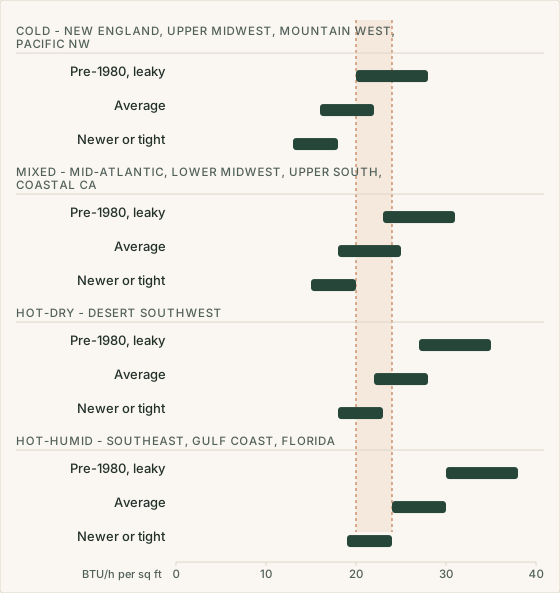
A 2,000 sq ft house in a mixed U.S. climate needs about 36,000–50,000 BTU/h of cooling — roughly 3 to 4 tons — while the same footage runs 4–5 tons in the hot-humid Southeast and can drop to 26,000–36,000 BTU/h in a tight newer cold-climate build. The working rule behind those brackets is 1 ton per 400–600 sq ft, shifted by climate, insulation era, and ceiling height; a contractor's Manual J makes the final call.
Part A brackets your cooling load in BTU/h and tons from square footage, climate, and insulation — always as a range, never a single number. Part B shows what replacing an old SEER 8–13 unit with a new 14.3–18 SEER2 unit saves per year, and whether a higher tier pays for itself.
Not sizing advice — read this first
Every output here is a budget-planning estimate before your contractor's ACCA Manual J load calculation. A Manual J models your actual windows, orientation, air leakage, ducts, and local design temperatures. Use this tool to sanity-check a proposal, not to buy equipment.
Last reviewed 2026-07-22 · pricing data as of 2026-07 · how we build these numbers
Before you buy anything
These ranges are a budget-planning estimate before your contractor's ACCA Manual J — not professional sizing advice. Ask every bidder for the Manual J report behind their proposed tonnage. A contractor who sizes by square footage alone is guessing with your money, and oversized systems short-cycle, dehumidify poorly, and die younger.
How this estimate is built
Both parts of the tool run simple, fully disclosed arithmetic:
- BTU-per-square-foot band. Your climate region and insulation era select a cooling band — from 13–18 BTU/sq ft (cold climate, tight newer construction) up to 30–38 BTU/sq ft (hot-humid climate, leaky pre-1980 construction). The matrix is an interpolation of published sizing rules of thumb, anchored on ~20 BTU/sq ft for an average mixed-climate home, and it deliberately outputs a range, never one number.
- Ceiling factor. The bands assume 8-ft ceilings, and the factor is deliberately damped rather than proportional: 1 + 0.5 × (ceiling ÷ 8 − 1). A 9-ft ceiling adds 12.5% more air volume but only about 6% more load in this model, because the floor, roof, window, and infiltration loads that dominate a cooling calculation barely change when the wall gets a foot taller. The 0.5 damping is an editorial parameter, flagged as such in the data file — a Manual J prices your real geometry.
- Tons. BTU/h ÷ 12,000, rounded to the nearest half ton, the increment equipment is actually sold in. As a cross-check, most homes land at 1 ton per 400–600 sq ft.
- SEER2 conversion. Your old unit's SEER nameplate is multiplied by 0.95 to approximate its SEER2 equivalent under the DOE's 2023 M1 test, so the old and new units are compared on the same scale.
- Annual kWh and dollars. tons × 12,000 BTU/h × annual full-load cooling hours ÷ (SEER2 × 1,000) gives kWh; kWh × your electric rate gives dollars. The regional hour presets are medians of EPA/ENERGY STAR city values.
- Step-up payback. The annual savings of a 15.2, 16, or 18 SEER2 tier over the 14.3 base tier is divided into the installed price difference between those tiers (3-ton anchors) for a simple payback in years.
Data sources
Annual full-load cooling hours: EPA 2002 dataset as published in the ENERGY STAR Air Source Heat Pump Savings Calculator assumptions sheet (2016 edition, parsed 2026-07). Electric rate default: EIA Electric Power Monthly, Table 5.6.A, U.S. average residential price, April 2026. SEER→SEER2 factor: DOE 2023 appliance standard (M1 test). Equipment price trend: BLS Producer Price Index series PCU333415333415, +3.2% year over year through May 2026. Labor context: BLS OES occupation 49-9021, national median wage series OEUN000000000000049902108 (May 2025). Sizing bands: interpolated rule-of-thumb matrix, flagged as such in the data file. See methodology for the full trail.
HVAC tonnage by square footage — the honest version
Every "hvac tonnage calculator by square footage" ultimately leans on the same rule of thumb: 1 ton of cooling per 400–600 square feet. Applied honestly, that means a 1,500 sq ft house brackets at 2.5–3.5 tons, a 2,000 sq ft house at 3.5–5 tons in hot climates but 3–4 tons in mixed ones, and a 3,000 sq ft house at 5 tons or a two-system split. The spread is not sloppiness — it is the real range that climate, insulation, windows, and duct location create. Sites that hand you a single tonnage for "2,000 sq ft" are hiding that uncertainty; we print it. Where your home falls inside the band depends mostly on two things you told the tool: how hot and humid your summers run, and how leaky your envelope is. A pre-1980 house that has never been air-sealed can genuinely need 50% more capacity than a 2015 build of identical size.
BTU math for house heating and cooling
This tool brackets the cooling load. Heating BTUs follow the same logic with different constants: furnace sizing guides run roughly 30–40 BTU/sq ft of heating input in hot climates, 40–50 in mixed ones, and 50–60 in cold ones — so the same 1,800 sq ft mixed-climate house that needs about 32,000–45,000 BTU/h of cooling lands near a 72,000–90,000 BTU/h heating input, which is why the 80,000 BTU furnace class is so common. If you are pricing the whole box — furnace plus AC together — our HVAC system replacement calculator prices that scope; if only the AC side is failing, the AC replacement cost calculator owns the equipment and installation numbers.
Why the climate region moves the answer so much
The four regions are a deliberate simplification of the IECC climate-zone map. This is what each one covers:
| Region | What it covers |
|---|---|
| Hot-humid | The Southeast and Gulf Coast — Florida, coastal and east Texas, Louisiana, Mississippi, Alabama, Georgia, South Carolina |
| Hot-dry | The desert Southwest — Arizona, southern Nevada and New Mexico, inland Southern California, west Texas |
| Mixed | The Mid-Atlantic, lower Midwest, upper South, and coastal California |
| Cold | New England, the upper Midwest and Great Lakes, the Mountain states, and the Pacific Northwest |
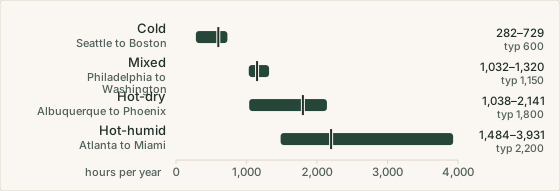
Region matters twice. It sets the design load (a Miami house fights both heat and humidity that a Denver house never sees), and it sets the annual run hours that decide whether efficiency upgrades pay: the EPA full-load-hours dataset puts Seattle at 282 hours a year and Miami at 3,931 — a 14-to-1 spread on the exact same equipment.
What a SEER step-up is really worth
For a 3-ton system at the 18.83¢/kWh national average rate, a base 14.3 SEER2 unit costs about $284 a year to run on a cold-climate cooling season (600 full-load hours), $545 in a mixed climate (1,150 hours), $853 in the hot-dry Southwest (1,800 hours), and $1,043 in the hot-humid South (2,200 hours). Stepping that unit up to 16 SEER2 saves $30 / $58 / $91 / $111 a year respectively; stepping to 18 SEER2 saves $58 / $112 / $175 / $214. Against installed price differences of roughly $1,370–1,830 (to 15.2), $2,460–3,270 (to 16-class two-stage), and $3,750–5,000 (to 18-class inverter) — condenser list-price deltas times the disclosed 1.2–1.6× markup — the pattern is blunt: in mixed and cold climates, a 14-to-16 SEER jump rarely pays back on energy alone within the equipment's ~15-year life; in hot-humid and hot-dry climates it takes a very long cooling season or a well-above-average electric rate to get there. Two honest caveats: the published full-load hours skew high (metering studies find real usage at 60–70% of them), and higher tiers also buy quieter operation and better humidity control — real benefits this tool does not price.
What can push you outside these bands
- Glass and orientation — big west-facing windows can add a half ton by themselves; a Manual J counts them, square footage does not.
- Ducts in the attic — leaky attic ductwork can waste 20–30% of capacity, which shows up as an "undersized" system that is really a duct problem.
- Real electric rates — the 18.83¢ national average hides a 12¢-to-35¢ spread; the savings math scales linearly with your actual rate, so use your bill.
- Heat pumps — if you are weighing a heat pump instead of a straight AC-plus-furnace setup, the operating math changes; our heat pump vs. gas furnace cost guide walks through it with the same show-the-math approach.
Frequently asked questions
What size AC unit do I need for a 2,000 sq ft house?
In a mixed climate with average insulation and 8-foot ceilings, plan around 36,000–50,000 BTU/h — roughly 3 to 4 tons. The same 2,000 sq ft house needs about 48,000–60,000 BTU/h (4 to 5 tons) in the hot-humid Southeast, while a tight newer build in a cold climate may need only 26,000–36,000 BTU/h. That spread is exactly why a Manual J load calculation, not square footage alone, should pick the final size.
Is a 16 SEER unit worth the extra cost over 14 SEER?
On energy alone, usually not in mixed or cold climates: for a 3-ton system at the 18.83¢/kWh national average rate, stepping from 14.3 to 16 SEER2 saves about $30–58 a year there, against an installed price difference of roughly $2,460–3,270 — a payback far beyond the equipment's roughly 15-year life. In hot-humid or hot-dry climates the same step saves about $91–111 a year at the average rate, and it only pays back inside the unit's life with a very long cooling season (Gulf Coast, Florida) or an electric rate well above average.
How many square feet per ton of AC?
Most homes land at 1 ton of cooling per 400–600 sq ft of cooled floor area — hot climates and older, leaky homes toward 400 sq ft per ton, cold climates and tight newer homes toward 600. A proposal far outside that range deserves a direct question about the load calculation behind it.
What is the difference between SEER and SEER2?
SEER2 is the same efficiency concept measured under the DOE's 2023 M1 test procedure, which applies higher external static pressure to better match real duct systems. For split-system air conditioners, SEER2 comes out about 5% lower than the old SEER number for the same unit, so this tool multiplies your old unit's SEER rating by 0.95 before comparing it with new SEER2-rated equipment.
Can I use this instead of a Manual J load calculation?
No. This is a budget-planning estimate before your contractor's Manual J — it brackets the plausible size range so you can sanity-check proposals. A Manual J models your actual windows, orientation, air leakage, duct location, and local design temperatures, and it is the calculation your contractor should run — and show you — before you sign.