Sewer & water line replacement cost calculator
Replacing a 50-foot residential sewer lateral by open trench under lawn costs about $3,200–$10,000 all-in for 2026, with a typical project near $5,750 nationally — $50–$125 per installed foot plus surface restoration, camera inspection, and permit. Trenchless pipe bursting runs $60–$200 per foot plus a flat $1,000–$3,000 equipment mobilization: more upfront, and worth it mainly where digging itself is the expensive part — under slabs, whole-panel driveways, and deep or landscaped runs. Method, surface, depth, and run length control the spread.
Pick the line, the length, the method, and the burial depth. You get a per-foot rate you can challenge, plus every line item a real bid should show — excavation, surface restoration, trenchless mobilization, camera inspection, and the permit.
Last reviewed 2026-07-22 · pricing data as of 2026-07 · how we build these numbers
How this estimate is built
Five line items, added in the open — the same five a legitimate trenchless bid should show you (open trench has four, because its per-foot band already carries the dig):
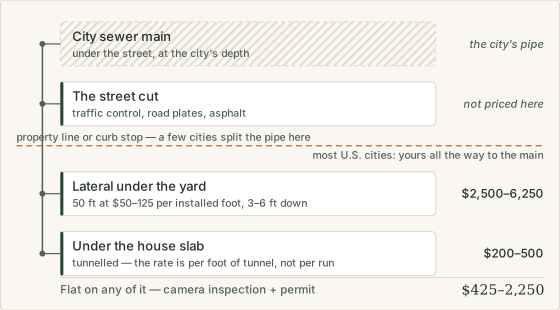
- Installed run. Your length is multiplied by a per-foot band for the line and method you chose. That band covers pipe, labor, and basic excavation or access pits, assuming a typical 3–6 ft burial — it deliberately excludes the items below, because bundling them is how per-foot quotes get muddy.
- Cast iron adder. If the existing pipe is cast iron, we add an estimated $15–$75 per foot for cutting, heavier demolition, and disposal — or, when you choose CIPP lining, for the heavy descaling a liner needs before it can bond to the host pipe. This spread is a derived allowance bracketed against published cast-iron versus PVC material costs, not a surveyed figure — so treat it as an estimate and ask bidders to price it explicitly.
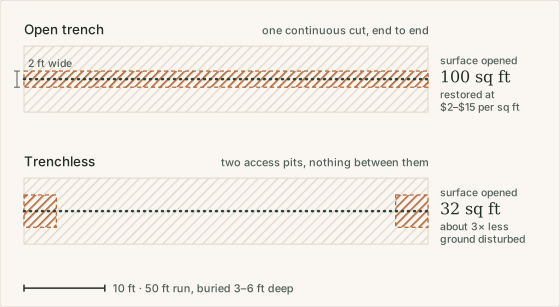
- Surface restoration. Open trenching disturbs a strip about 2 ft wide along the whole run; trenchless methods disturb only two access pits (~32 sq ft total). Lawn goes back for $2.50–$15 per sq ft (derived), concrete for $10–$25 per sq ft (sourced), and under-slab work is priced as tunneling at $200–$500 per foot — the same access math we walk through in our slab leak repair guide.
- Trenchless mobilization. Bursting and lining crews bill a fixed mobilization-and-setup charge that doesn't shrink with footage. NuFlow's 2026 guide works the example: a 20 ft job near $5,000 against a 60 ft job near $9,000 — a fixed component near $3,000 including permits and setup. We carry it as a flat $1,000–$3,000 band, applied to every trenchless method and never to open trench. That band is derived by netting out the camera inspection and permit, which we itemize separately.
- Inspection and permit. A camera inspection runs $125–$750 depending on cleanout access, and municipal sewer permits run $300–$1,500 across published city fee schedules.
Data sources
Per-foot bands are cross-referenced from five sources, all retrieved 2026-07-04 and re-observed 2026-07-22: HomeGuide and Angi cost guides; NuFlow's published CIPP rates and its 2026-01-27 trenchless cost guides, which also anchor the mobilization band; This Old House's 2026-03-30 sewer guide, whose cost data comes from Angi, for material history and cast-iron figures; and Anchor Foundation Repair's published tunneling rates. Labor context (not a formula input): BLS OES May 2025, SOC 47-2152 Plumbers, Pipefitters, and Steamfitters — national median $30.67/hr, series OEUN000000000000047215208. Materials tracked via BLS PPI plastics pipe, series WPU07210603 (181.528, May 2026); no active industry PPI exists for NAICS 237110 sewer construction, so we say so rather than cite one. Pricing data as of 2026-07. See methodology for the full trail.
Sewer line replacement cost per foot, without the fog
Per-foot pricing is where sewer bids hide the ball, because "per foot" means different things in different quotes. Some include restoration; most don't. Some include the permit; almost none say. Our bands are installed pipe, labor, and excavation only — everything else is a separate line, so when a bid says $180 per foot you can ask precisely what's inside that number.
| Line & method | Low | Typical | High |
|---|---|---|---|
| Sewer — open trench | $50/ft | $85/ft | $125/ft |
| Sewer — pipe bursting (trenchless) | $60/ft | $130/ft | $200/ft |
| Sewer — CIPP lining (trenchless) | $80/ft | $160/ft | $250/ft |
| Water main — open trench | $40/ft | $75/ft | $125/ft |
| Water main — trenchless pull | $75/ft | $125/ft | $250/ft |
One reading note on the table: the trenchless rows carry an additional flat $1,000–$3,000 equipment mobilization per job, itemized separately in the calculator. A trenchless per-foot rate quoted alone understates the bid — most sharply on short runs, where the flat charge dominates the total.
The water service line is the smaller sibling of this job: usually a 3/4–1 inch supply pipe rather than a 4-inch waste pipe, often shallower, and faster to dig. That's why main water line replacement cost per foot starts lower — but the restoration and permit line items behave exactly the same way, which is why the calculator handles both lines with one set of books.
Two things decide how a water service line prices that sewer laterals mostly don't. First, frost depth: code requires the supply line to sit below the local frost line, which runs from mere inches in the Gulf South to 5–6+ ft across the upper Midwest and New England — the same 40 ft of pipe can be a shallow one-day dig in Houston and a deep, shored excavation in Minneapolis, so regional quotes diverge more than a national band suggests. Second, lead: if your home predates the 1986 lead ban, the service line itself may be lead or galvanized piping downstream of lead. Under EPA's 2024 Lead and Copper Rule Improvements, water utilities must inventory every service line and replace lead lines on a 10-year schedule starting in 2027 — so before paying to replace a water service, check your utility's published service-line inventory: many utilities cover the public side, some fund the private side, and a scheduled utility replacement can turn your solo project into a coordinated (and cheaper) one.
Trenchless vs. open trench: compare totals, and know what each is for
Pipe bursting typically prices 20–40% higher per foot than open trenching, and every trenchless job starts with a flat $1,000–$3,000 equipment mobilization before the first foot is priced. Run the honest math on a 50 ft lawn run and the dig wins: open trench totals $3,175–$10,000 (typical $5,750) against $4,505–$15,730 (typical $9,592) for bursting. Change what sits above the pipe, though, and the verdict can flip — we work the same run under a concrete driveway and a slab, line by line, in the surface-by-surface method guide. Whatever your surface: run both methods through the calculator above, compare totals, and ask each bidder to state restoration and mobilization as separate lines — a contractor who won't itemize them is quoting you a number they can revise later.
One honest caveat: not every line qualifies for trenchless. A collapsed pipe can't guide a bursting head, and a badly bellied line can't be lined — liners follow the pipe's shape. CIPP also assumes the host pipe can be cleaned and descaled enough for a liner to bond; in heavily scaled cast iron that prep is its own budget line, which is why our cast-iron adder switches to descaling-and-prep pricing when you select lining. The camera inspection is what tells you which menu you're ordering from — get it before you collect bids, not after.
The 50-foot scenario, itemized
Fifty feet is the workhorse residential lateral, so here's the default calculation in full. Open trench under lawn: 50 ft × $50–$125 gives $2,500–$6,250 for the run. Restoring the roughly 100 sq ft trench scar of lawn adds $250–$1,500. Camera inspection adds $125–$750 and the permit $300–$1,500. Total: $3,175–$10,000, typical near $5,750 nationally. Published guide totals for 50–100 ft laterals run $3,000–$20,000 — our range sits inside theirs because we hold length constant at 50 ft and price restoration for lawn, not concrete. If every bid you collect lands above our high band, something specific is driving it: a burial deeper than the typical 3–6 ft, rock, a street cut, cast iron, or a high-wage market. Ask the bidder which one — an itemized answer is the whole point of collecting itemized bids.
Cost by run length: open trench vs. pipe bursting
The same line items, worked across five run lengths. Three of them are flat charges that don't shrink with a short run — the camera inspection ($125–$750), the permit ($300–$1,500), and pipe bursting's $1,000–$3,000 equipment mobilization — and bursting's restoration covers the same two access pits (32 sq ft of lawn) at any length, while open-trench restoration grows with the trench itself (2 sq ft of lawn per foot). That's why a 20 ft job costs far more per foot than a 100 ft job, most sharply on the trenchless side:
| Run length | Open trench | Pipe bursting (trenchless) |
|---|---|---|
| 20 ft | $1,525–$5,350 (typical $2,840) | $2,705–$9,730 (typical $5,692) |
| 40 ft | $2,625–$8,450 (typical $4,780) | $3,905–$13,730 (typical $8,292) |
| 50 ft | $3,175–$10,000 (typical $5,750) | $4,505–$15,730 (typical $9,592) |
| 75 ft | $4,550–$13,875 (typical $8,175) | $6,005–$20,730 (typical $12,842) |
| 100 ft | $5,925–$17,750 (typical $10,600) | $7,505–$25,730 (typical $16,092) |
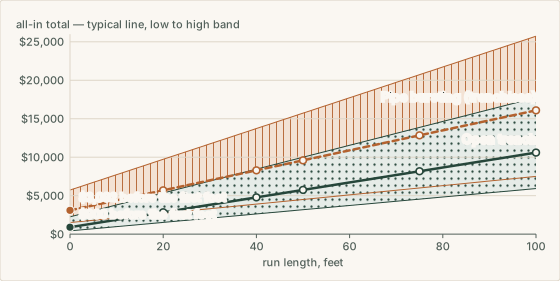
Basis: sewer lateral under lawn, itemized exactly as the calculator does it — length × per-foot band ($50–$125 open trench, $60–$200 pipe bursting), plus lawn restoration at $2.50–$15 per sq ft (2 ft × length for open trench; 32 sq ft of pits for bursting), plus bursting's flat $1,000–$3,000 mobilization, plus camera inspection and permit. No cast iron adder. NuFlow's 2026 short-run guidance — $3,000–$7,000+ all-in for trenchless jobs under 30 ft — brackets our 20 ft trenchless row. And if you're still weighing a spot repair against full replacement, our sewer camera inspection guide walks through how the footage settles that call.
Cast iron, clay, and Orangeburg in an older house
If your home predates roughly 1975, the yard lateral is most likely vitrified clay or Orangeburg rather than cast iron — cast iron dominated the drains under and inside the house, and full cast-iron laterals show up mainly in certain regional markets. All three materials are on the clock: HomeGuide's 2026 guide puts Orangeburg and clay at 30–60 years of service and cast iron at 50–100 (This Old House cites 75–100 with proper care), so mid-century pipe is failing on schedule, not by accident. Replacing cast iron costs more than replacing clay or PVC because the pipe must be cut rather than cracked, the demolition is heavier, and the iron has to be hauled and disposed of. Our adder prices that at an estimated $15–$75 per foot on top of the standard band — a derived allowance, labeled as such — and switches to descaling-and-prep pricing when you choose CIPP lining, because a liner leaves the host pipe in place but needs the scale ground out first. When under-slab cast-iron drains come out through concrete, project totals commonly reach $10,000–$30,000. Owners of houses from this era often face the companion problem indoors: original galvanized supply pipes from the same build. If that's you, price the whole-house repipe at the same time — mobilizing one plumbing crew for both jobs beats mobilizing two crews a year apart.
Orangeburg deserves its own paragraph. From the mid-1940s to the early 1970s, huge numbers of laterals were laid in bituminous fiber pipe — wood pulp and coal tar, sold most widely under the Orangeburg name — and This Old House's 2026 guide notes it has since been superseded by PVC for good reason. Orangeburg doesn't crack the way clay does; it absorbs moisture, blisters, and slowly ovalizes. That failure mode matters for method choice: once the bore has deformed, a liner can't restore the shape — CIPP follows the host pipe's geometry — so a flattened Orangeburg line is a bursting or open-trench conversation, not a lining one. It's the single strongest argument for putting a camera down any line from this era before collecting bids: the material on the video decides which menu you're ordering from.
What can move your real price outside this range
- Depth. Bands assume a typical 3–6 ft burial. OSHA 29 CFR 1926.652 requires cave-in protection — sloping, shoring, or shielding — in trenches 5 ft and deeper (stable rock is the only carve-out), so nearly every lateral dig already runs under trench-safety rules; past roughly 6 ft the excavation widens, spoil handling grows, and per-foot costs climb fast. That's why the calculator's depth selector flags deep runs as out-of-band instead of pretending the same numbers still apply.
- Regional labor. These are national bands. BLS state medians for plumbers run from 24% below the national median (Arkansas) to roughly 50% above it (Illinois, Oregon, DC), and billed rates follow. A few utility districts also add their own lateral rules — in California's East Bay, for example, EBMUD requires a private sewer lateral compliance certificate when a home sells, which can push this project onto an escrow timeline.
- The street cut. If the failed section reaches under the public road, traffic control, road plates, and asphalt restoration can add thousands — and some cities require their own contractors for the public portion.
- Who owns which segment. Most U.S. cities make the homeowner responsible for the full lateral to the main, but some split at the property line or curb stop. Check before assuming the city pays for anything.
- Soil and rock. Ledge, boulders, or high groundwater turn a one-day dig into three.
- Local permit regimes. Our $300–$1,500 permit band spans published city fees; a few municipalities also require inspection by their own crews at extra cost.
Frequently asked questions
How much does sewer line replacement cost per foot?
Open-trench sewer line replacement runs $50–$125 per installed foot in 2026. Trenchless pipe bursting runs $60–$200 per foot and CIPP lining $80–$250 — plus a flat $1,000–$3,000 equipment mobilization per trenchless job that per-foot quotes usually hide, which is why a short trenchless run costs far more per foot than a long one. Surface restoration, camera inspection, and permits sit on top, and we itemize every one of them separately.
What does it cost to replace 50 feet of sewer line?
For a 50-foot sewer lateral dug through lawn, our itemized math lands at roughly $3,200–$10,000 all-in nationally: $2,500–$6,250 for the installed run, $250–$1,500 to restore the lawn, $125–$750 for a camera inspection, and $300–$1,500 for the permit. Published guide totals of $3,000–$20,000 for 50–100 foot laterals bracket the same range.
Is trenchless replacement worth the higher per-foot price?
Sometimes — compare totals, not per-foot rates. Pipe bursting prices 20–40% higher per foot and carries a flat $1,000–$3,000 mobilization, so on an open lawn run the dig usually wins on dollars. Trenchless earns its price where digging is the expensive part: under-slab runs (tunneling prices at $200–$500 per foot), driveways that need whole panels replaced rather than a strip patch, deep laterals, and mature landscaping. The calculator prices both methods with every line item shown.
Why does cast iron cost more to replace?
Cast iron must be cut rather than cracked, the demolition is heavier, and the old iron has to be hauled and disposed of — our adder prices that at an estimated $15–$75 per foot over replacing clay or PVC, labeled as a derived estimate. If you line the pipe instead of digging, the same budget line becomes heavy descaling before the liner goes in. Cast iron drains serve 50–100 years, so mid-century lines are reaching the end of that schedule, and under-slab cast-iron replacements commonly reach $10,000–$30,000.
How much does main water line replacement cost per foot?
Replacing the water service line from the meter to the house runs about $40–$125 per foot open trench, or $75–$250 per foot for a trenchless pull, installed. The same restoration and permit line items apply, though water lines usually sit shallower than sewer laterals and dig faster — except in cold climates, where the line must sit below the local frost depth and the dig gets deeper and pricier.
Disclaimer: these are independent planning ranges built from published data — not quotes, bids, or professional advice. Underground work carries genuine unknowns until the ground is open; get at least three written, itemized bids and a camera inspection before committing.