Exterior house painting cost calculator
Painting the exterior of a two-story house with a 2,000 sq ft footprint costs roughly $4,950–$11,880 on vinyl siding in 2026, with a typical job near $7,920; a one-story home on the same footprint runs $2,550–$6,120. Siding material sets the rate — $1.50–$3.60 per sq ft of wall for vinyl, up to $2.50–$5.60 for brick — and stories, prep condition, and any trim package scale it from there. All rates build up from published painting-cost guides and retail paint prices, with BLS painter wages as a regional cross-check.
Enter your home's footprint, number of stories, siding type, and paint condition. You get a low / typical / high installed-cost range — plus the wall-area conversion and every rate we used, so you can challenge any assumption.
Last reviewed 2026-07-22 · pricing data as of 2026-07 · how we build these numbers
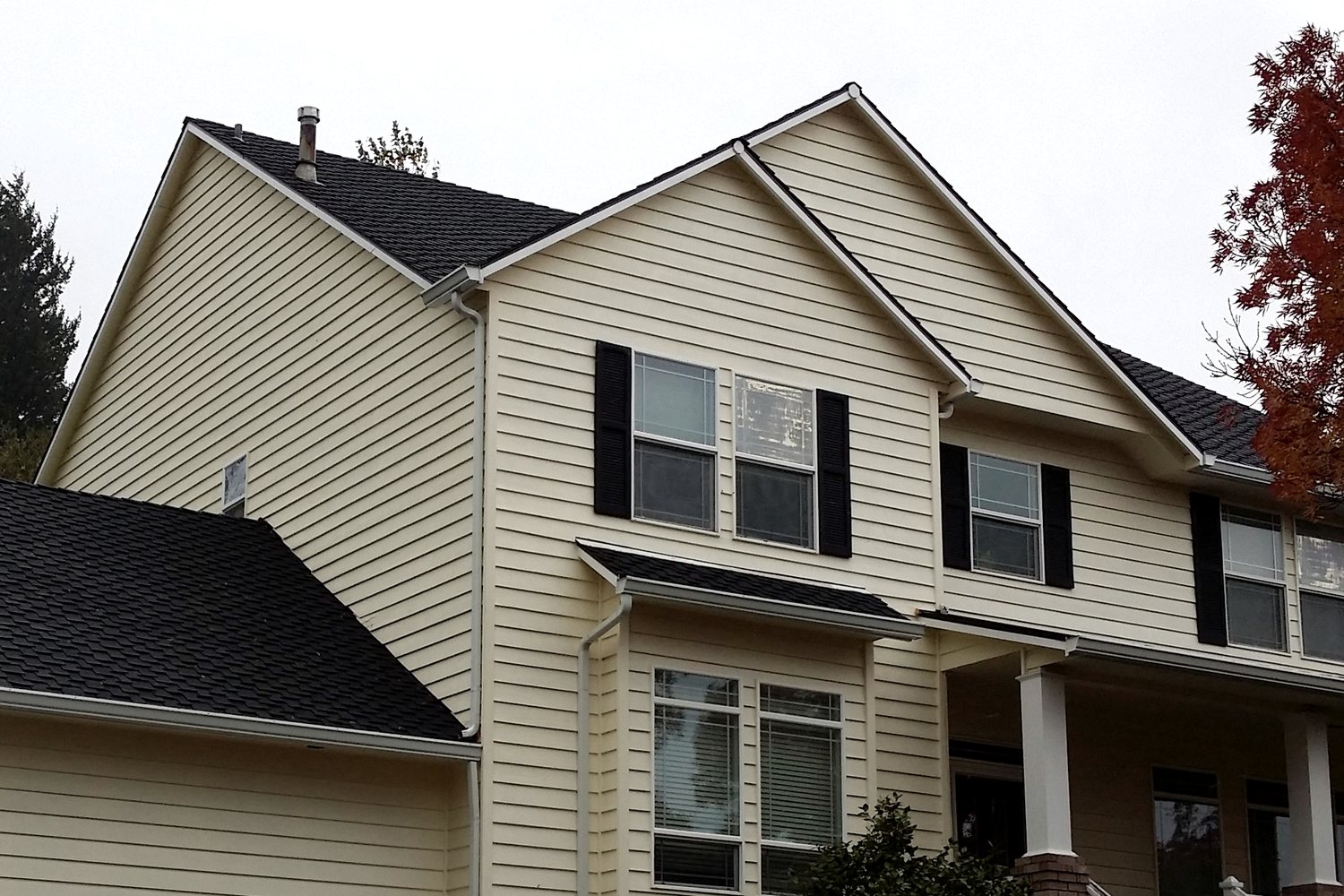
- Siding — priced per square foot of wall, and the material you name sets the base rate before anything else
- Gable — the triangle a footprint never shows. Our geometry factor adds 10% of wall area for gable ends
- Trim — casings, corner boards and fascia, billed by the linear foot — the adder assumes about 400 of them
- Shutters — counted, not measured. The same optional adder assumes eight of them on the whole house
How this estimate is built
The calculator does exactly four things, in the open:
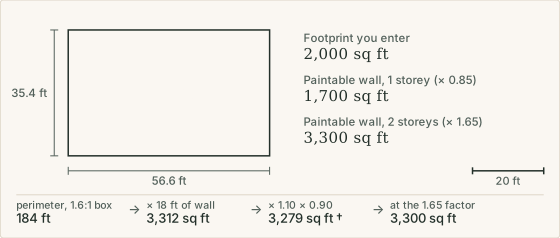
- Wall area. Your footprint is multiplied by a story factor — 0.85 for one story, 1.25 for 1.5 stories, 1.65 for two, 2.45 for three — to approximate paintable wall square footage. The factor is pure geometry: perimeter of a typical rectangular footprint × 9 ft of wall per story, plus 10% for gable ends, minus 10% for windows and doors. No published table exists for this conversion, so we derived it and show the work; if you know your true wall area, divide by your footprint and compare factors.
- Siding rate. Each material carries a low / typical / high installed cost per sq ft of wall — two coats, labor, paint, and standard washing and spot-priming included — from the sources listed below. Vinyl is cheapest at $1.50–$3.60; brick is dearest at $2.50–$5.60.
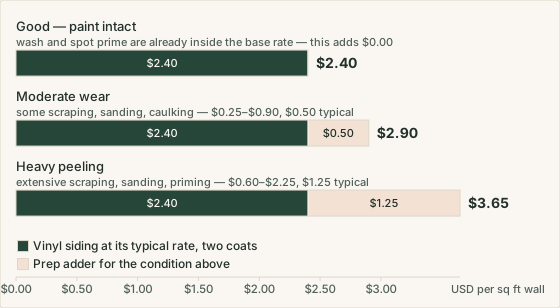
- Prep adder. If your existing paint shows moderate wear, we add $0.25–$0.90 per sq ft for scraping, sanding, and caulking; heavy peeling adds $0.60–$2.25. Homes in good condition add nothing, because a wash and spot-prime are already inside the base rates.
- Trim & shutters. An optional flat adder of $550–$2,000 covering roughly 400 linear ft of trim and fascia plus 8 shutters — a disclosed assumption, since almost nobody knows their trim footage. Skip the toggle if you are painting body only.
Data sources
Labor basis: BLS Occupational Employment and Wage Statistics, May 2025, painters, construction and maintenance (occupation 47-2141) — national median $23.75/hr, series OEUN000000000000047214108, pulled 2026-07-04. Installed rates cross-referenced against Homewyse calculators dated May 2026, Angi and HomeGuide 2026 guides, and retail exterior paint prices retrieved 2026-07-04. The paint anchors are Behr Ultra Exterior at $38–$42/gal at Home Depot and Sherwin-Williams Duration at about $80/gal. BLS publishes no producer price index for painting contractors — we verified NAICS 238320 returns no series — so this vertical is anchored on OES wages plus dated retail prices. Pricing data as of 2026-07. See methodology for the full trail.
Cost per square foot by siding material
All figures are installed cost per square foot of wall area (not floor area), two coats, including standard prep:
| Siding | Low | Typical | High |
|---|---|---|---|
| Vinyl | $1.50 | $2.40 | $3.60 |
| Fiber cement (Hardie) | $1.60 | $2.50 | $3.60 |
| Wood | $2.00 | $3.00 | $4.50 |
| Stucco | $2.20 | $3.30 | $4.90 |
| Brick | $2.50 | $3.80 | $5.60 |
The typical column is the midpoint of overlapping published ranges — a blend we disclose rather than a single-source number. Why the spread between materials? Texture and absorption. Stucco and brick are porous and rough: they drink more paint per coat, often need a masonry primer, and slow the crew down. Vinyl and fiber cement are smooth, factory-finished surfaces that spray quickly. One vinyl-specific caution: going darker than the original siding color calls for a "vinyl-safe" paint formulation — conventional dark colors absorb enough solar heat to warp vinyl panels, and warped siding is a replacement bill, not a repaint. Wood sits in between, but it is also the material most likely to need the prep adders below — peeling is a wood problem far more than a vinyl one.
Cost by footprint and stories
The calculator's own geometry, worked across common footprints on vinyl siding in good condition, no trim adder — footprint × story factor (0.85 for one story, 1.65 for two) gives the wall area, wall area × $1.50–$3.60 gives the cost:
| Footprint | 1 story — wall area | 1 story — cost | 2 stories — wall area | 2 stories — cost |
|---|---|---|---|---|
| 1,000 sq ft | 850 sq ft | $1,275–$3,060 (typical $2,040) | 1,650 sq ft | $2,475–$5,940 (typical $3,960) |
| 1,500 sq ft | 1,275 sq ft | $1,913–$4,590 (typical $3,060) | 2,475 sq ft | $3,713–$8,910 (typical $5,940) |
| 2,000 sq ft | 1,700 sq ft | $2,550–$6,120 (typical $4,080) | 3,300 sq ft | $4,950–$11,880 (typical $7,920) |
| 2,500 sq ft | 2,125 sq ft | $3,188–$7,650 (typical $5,100) | 4,125 sq ft | $6,188–$14,850 (typical $9,900) |
Other siding types scale the same wall areas by their own rates from the table above — wood, stucco, and brick land higher — and prep adders and the trim package sit on top. Remember the footprint is the ground floor only: a 2,000 sq ft living-area home on two stories belongs in the 1,000 sq ft row.
Why stories move the bill twice
A second story raises the price through two separate doors, and it helps to keep them apart when reading bids. First, area: two stories of wall on the same footprint roughly doubles the paintable surface — our factors go from 0.85 to 1.65. Second, access: everything above the first floor happens from ladders or staging, which slows production. Angi's 2026 guidance puts the total two-story premium at 20–35% over a comparable one-story home; most of that is the area growth our story factor already captures, so we fold the remaining access cost into the high band rather than double-charging the typical one. On three-story walls, scaffolding alone can run $500–$2,000 — if your home is tall and tight to the lot line, budget toward the high band and say so when collecting bids.
What prep really costs
Prep is the least visible and most decisive line on a painting bid. Published 2026 figures put scraping and sanding of weathered siding at $0.50–$2.50 per sq ft — on a heavily peeling 3,000 sq ft wall, that is potentially more than the paint labor itself, and on neglected exteriors as much as 70% of total crew hours goes to prep before a brush touches paint. Our base rates already include the standard routine, so the condition selector only adds cost where your surface genuinely demands more. That routine is about two labor-hours per 350 sq ft: pressure wash, remove loose paint, spot-prime, caulk. Be honest with it: a low bid that assumes "good" condition on a peeling house is not a bargain, it is a change order waiting to happen.
Pre-1978 homes: lead paint and the EPA RRP rule
If your home was built before 1978, federal law changes who may do the prep and how. Under the EPA's Renovation, Repair and Painting (RRP) rule, any firm paid to disturb painted surfaces in pre-1978 housing must be EPA Lead-Safe certified, with the work done or supervised by a certified renovator using lead-safe practices — containment sheeting on the ground, no open-flame burning or uncontained power sanding, HEPA-assisted cleanup, and recordkeeping. The rule's minor-repair exemption stops at 20 sq ft of exterior painted surface, and full-exterior scraping and sanding blows past that on the first wall, so assume it applies to any real pre-1978 repaint unless testing shows the paint is lead-free. None of that scope is inside our bands: the containment, slower prep, cleanup, and disposal add real labor and material, so on a pre-1978 exterior with failing paint, read the calculator's result at or above the high band. Treat a bid on such a house that never mentions lead, testing, or certification as a compliance red flag rather than a bargain — the liability for uncontained lead dust lands on the homeowner's property either way.
What can move your real price outside this range
- Regional labor — painter wages vary widely; the BLS state medians run from about $19.28/hr in Arkansas to $32.80/hr in Hawaii around the $23.75 national median, and coastal metros commonly bid 15–30% above the typical band.
- Paint grade — the bands assume mid-grade exterior paint around $38–$42/gal; premium lines near $80/gal add real money on a 15–25 gallon job.
- Rot and repair — carpentry to replace damaged siding, sills, or fascia is billed separately from painting and only fully visible after washing.
- Complexity — many corners, deep eaves, multiple accent colors, and heavy landscaping to protect all add hours the flat geometry factor cannot see.
- Timing — exterior painting is seasonal; late-spring backlogs price higher than shoulder-season slots in most markets.
If your project list also includes the deck, stain pricing works differently from siding paint — see our deck staining cost guide for per-square-foot rates and a worked 300 sq ft example. And the same show-the-math approach backs our roof replacement calculator if you are sequencing exterior work; the quote checklist applies to painting bids nearly line for line, too. If the repaint continues indoors, the interior version of this worksheet prices walls, ceilings, trim, and doors room by room.
Frequently asked questions
How much does it cost to paint a two-story house exterior?
A two-story home with a 1,000 sq ft footprint — roughly 2,000 sq ft of living area — carries about 1,650 sq ft of paintable wall. At vinyl-siding rates of $1.50–$3.60 per sq ft, that is roughly $2,500–$5,900 for walls in good condition. Wood, stucco, or brick siding, heavy prep, and a trim package can push a two-story job past $10,000.
How much does it cost to paint a brick house exterior?
Painted brick runs $2.50–$5.60 per sq ft of wall in our data — the highest of the five siding types — because porous masonry drinks paint and needs a masonry primer. A one-story brick ranch with a 1,500 sq ft footprint has about 1,275 sq ft of wall, so the typical job lands near $4,800 and the full range spans roughly $3,200–$7,100 before prep repairs or trim.
What does it cost to paint a 2,000 sq ft house exterior?
It depends on what the 2,000 sq ft measures. A 2,000 sq ft footprint on two stories is about 3,300 sq ft of wall — roughly $7,900 typical on vinyl siding, and $5,000–$11,900 across the bands. If 2,000 sq ft is the living area of a two-story home, the footprint is nearer 1,000 sq ft and the typical vinyl job is about $4,000. Enter the ground-floor footprint, not the living area, and the calculator handles the rest.
Why do you ask for footprint and stories instead of wall area?
Almost nobody knows their paintable wall area, but the ground footprint is on county records and listing sites. We convert it with a disclosed geometry factor — 0.85 for one story up to 2.45 for three — built from perimeter times wall height, plus 10% for gable ends, minus 10% for windows and doors. The factor is printed in the worksheet so you can correct it if your home is unusually long, tall, or glassy.
Is this a quote?
No. It is a planning range built from published wage and price data, meant to tell you whether a real bid is in reasonable territory. Get at least three written bids, and ask each painter to state the wall square footage and prep scope they priced so you can compare their numbers against this worksheet line by line.