Water heater replacement cost calculator
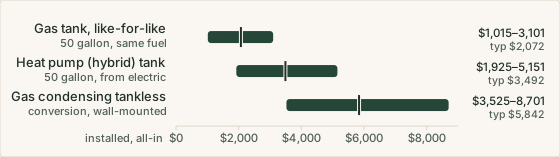
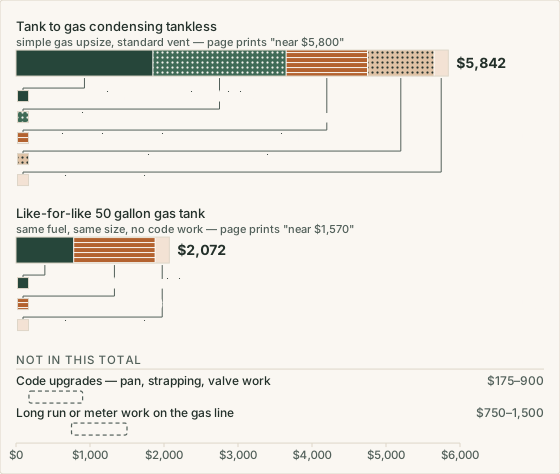
A like-for-like 50 gallon gas water heater swap costs $1,015–$2,500 installed in 2026, with a typical bill near $1,570. Converting that tank to a gas condensing tankless unit is a different project at $3,500–$8,700 — typically near $5,800 — because the gas line upsize, new venting, and wall-mounting together cost more than the unit itself. Both figures itemize retail unit prices, surveyed plumber labor (with the BLS wage series printed as context), and surveyed permit fees.
Pick your current heater and what you're replacing it with — a same-size tank, a heat pump (hybrid) tank, or a tankless conversion. You get an itemized low / typical / high range: unit, labor, gas line, venting, electrical, code upgrades, permit, and disposal, each priced from a named source.
Last reviewed 2026-07-22 · pricing data as of 2026-08 · how we build these numbers
How this estimate is built
Every line item is a published price band, added together — no black-box "regional factors":
- Unit band. Each size and type carries a low / typical / high retail price anchored to listed prices retrieved in July 2026. Which retailer anchors which unit: Home Depot for Rheem Performance-line tanks and the Rinnai RX199iN condensing tankless; Ferguson for the Navien NPE-240A2; AF Supply for Rheem RTEX electric tankless, with heat pump units cross-listed against US Supply and Consumer Reports. Where only one SKU was directly observed, the band is bracketed by its cheaper 6-year and pricier 12-year siblings and flagged as interpolated in the dataset.
- Labor band. A like-for-like tank swap is 2–6 hours of plumber time ($300–$1,000 installed labor); a tank-to-tankless conversion is one to two full days ($800–$3,000). The bands come from 2026 HomeGuide and Angi installed-labor surveys; the BLS wage series below is printed as context and a sanity floor, not fed into the math.
- Adders. Tankless conversions expose extra line items only when they apply: gas line upsize ($350–$1,500), venting ($300–$1,200), circuit or panel work for electric tankless ($200–$2,000), plus optional wall-mount and relocation work ($500–$1,500). Heat pump tanks carry their own two: a dedicated 240V circuit if you're coming from gas ($250–$900) and condensate routing ($100–$600, a derived estimate flagged in the dataset).
- Code upgrades. Tank swaps in older homes rarely pass inspection as-is: an expansion tank runs $100–$400, and a fuller bring-to-code package (pan, strapping, valve work) $175–$900 (HomeGuide 2026). The selector defaults to none so a like-for-like comparison stays clean — but if your last heater went in fifteen years ago, expect at least the expansion tank.
- Permit and disposal. A $25–$201 permit (average $92 across a 27-city 2026 survey) and $50–$150 to haul away the old tank.
- Total. The bands are summed low-with-low, high-with-high. Real projects mix bands, so read the spread as your negotiating room, not a coin flip.
Data sources
Unit prices: Home Depot, Ferguson, and AF Supply listed prices, retrieved 2026-07; heat pump units cross-listed at US Supply and Consumer Reports, retrieved 2026-07-22. Labor: bands from HomeGuide and Angi 2026 installed-labor surveys ($45–$200/hr billed); BLS Occupational Employment and Wage Statistics, May 2025, SOC 47-2152 (Plumbers, Pipefitters, and Steamfitters), national median $30.67/hr — series OEUN000000000000047215208 — is cited as wage context and a floor check, not as a formula input. Code upgrade and circuit adders: HomeGuide water-heater-installation-cost, 2026-01-02 edition. Equipment price trend: BLS Producer Price Index, Domestic Water Heaters, series WPU106601 = 646.179 (May 2026). Permits: PermitCalculator 2026 survey of 27 US cities. Pricing data as of 2026-07. See methodology for the full trail.
Tank swap: what actually drives the bill
If you're replacing a tank with the same kind of tank, the bill has three parts, and the unit is usually the smallest surprise. A 40 gallon gas tank runs $580–$1,080 at retail, a 50 gallon $640–$1,150, and electric equivalents about $100–$200 less. Installed labor — draining the old tank, wrestling it out, setting the new one, sweating or press-fitting the connections — adds $300–$1,000. Code upgrades are the quiet budget-eater: if your last heater went in fifteen years ago, expect the installer to add an expansion tank, a drain pan, or seismic strapping that wasn't required then. The calculator's code-upgrade selector prices exactly that — $100–$400 for the expansion tank alone, $175–$900 for the fuller bring-to-code package (HomeGuide 2026) — as its own line instead of letting it hide inside "labor."
Here's the number most shoppers get wrong: 40 vs 50 gallons is nearly a rounding error. Within the same Rheem series at Home Depot in July 2026, the spread between a 40 and a 50 gallon unit was about $60–$90 — for example, $599 versus $679 list for the Performance Plus electric — and the labor to install either is identical. The installed totals differ by roughly 5%. If two showers back-to-back ever leaves your household cold, the bigger tank is the cheapest capacity upgrade in plumbing. The real price cliff sits at 75 gallons: those units start around $1,100 and often need a larger flue and a two-person crew, which is why the calculator prices that size on its own band.
Tank to tankless: where the money goes
A tankless conversion is not "an expensive water heater" — it's a modest unit price plus a stack of one-time infrastructure work. The gas condensing units most conversions choose run $1,500–$2,300. Two observed SKUs bracket that band: a Rinnai RX199iN listed at $1,532–$1,703 in July 2026, and Navien's NPE-240A2 between $1,720 and $2,266 depending on the supplier. The conversion labor is $800–$3,000 because the installer is re-plumbing supply lines to a wall-mounted unit, not dropping a tank onto the same stub-outs.
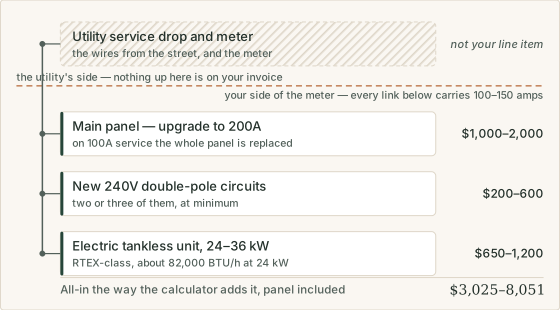
Then come the adders, and they're the whole reason quotes for the same unit vary by thousands. A 199,000 BTU burner draws four to five times the gas of a tank burner, so a home with 1/2-inch supply pipe to the heater needs an upsize to 3/4-inch: $350–$750 for a short, simple run, $750–$1,500 when the run is long or the meter is involved. The old tank's B-vent flue can't be reused; a condensing unit vents in PVC at $300–$800 for a standard run, more for roof penetrations. Electric tankless skips gas and venting entirely — the RTEX-class units are only $650–$1,200 — but draws 100–150 amps, which means new double-pole circuits at minimum and, on 100A service, a panel upgrade. If that's your situation, price the panel work separately with our electrical panel replacement calculator before you commit; a $1,500 panel job can erase the electric unit's price advantage. And one honest limit before the panel math: "whole-home" at 24–36 kW is a warm-climate claim. A 24 kW unit makes about 82,000 BTU/h, which sustains roughly 2.5 GPM against a 40°F northern winter inlet — one shower — versus roughly 4.7 GPM on 70°F Gulf South water. Size against your inlet temperature, not the brochure.
Stacked up, a typical gas conversion — unit, labor, simple gas upsize, standard new vent, wall-mount work, permit, disposal — lands near $5,800, inside an honest $3,500–$8,700 range. That's two to three times a like-for-like tank swap. The payback case rests on lifespan (20+ years versus 8–12 for tanks) and standby-loss savings, not on the install bill.
The heat pump (hybrid) option
A heat pump water heater is a tank that moves heat from the surrounding air instead of generating it — three to four times as efficient as a resistance electric tank, which HomeGuide's 2026 operating-cost table scores at roughly $160–$190 a year to run versus $530–$600 for standard electric. The units are no longer exotic, and the prices are observable: the retail Rheem ProTerra 50-gallon lists near $1,737 (Consumer Reports, July 2026), pro-tier Rheem PROPH50 and AO Smith Voltex units run $2,295–$3,160 at supply houses, and our band prices the spread at $1,550–$3,200. Replacing an existing electric tank is ordinary tank-swap labor plus two specifics the calculator itemizes: condensate routing at $100–$600, and, if you're coming from gas, a dedicated 240V circuit at $250–$900 (HomeGuide 2026). That condensate figure is a derived estimate rather than a surveyed one — the tank drips like an AC coil, and that water must reach a drain. All-in, the like-for-like electric swap prices at $1,925–$4,550 with a typical bill near $3,000 — squarely inside HomeGuide's $2,000–$4,600 installed range — and utility rebates where offered pull the net lower. Two practical checks before you order: the tank needs roughly 700+ cubic feet of air around it (or ducting) to have something to pull heat from, and it mildly cools and dehumidifies the space it sits in — a feature in a Texas garage, a tax in a Minnesota utility closet. There's a regulatory clock running too: DOE's April 2024 efficiency standard effectively requires heat-pump technology in most larger electric tanks manufactured from 2029, so the category you're comparing against today is the one the market is converging on.
What can move your real price outside this range
- Regional labor — these are national bands. BLS state medians for plumbers run from 24% below the national median (Arkansas) to roughly 50% above it (Illinois, Oregon, DC), and billed rates follow.
- Location of the heater — attic or crawl-space installs add hours; a garage swap next to the driveway sits at the low band.
- Condensate routing — condensing tankless units drip acidic condensate that must reach a drain; a far-away drain adds pump and line work.
- Emergency timing — a failed tank on a Saturday pays weekend rates. If your heater is past 10 years old, replacing on your schedule is cheaper than on its schedule. The same planning logic applies to the pump in your basement floor — see our sump pump cost guide.
- Pipe condition — installers who find corroded galvanized or failing polybutylene supply lines will (rightly) flag it. If that conversation is coming, get ahead of it with the whole-house repipe calculator.
Frequently asked questions
How much does it cost to replace a 50 gallon water heater?
For a like-for-like 50 gallon gas swap, our July 2026 data stacks up to $640–$1,150 for the unit, $300–$1,000 for installed labor, and $75–$350 for permit and disposal — roughly $1,015–$2,500 all-in, with a typical bill near $1,570.
Is a 40 gallon water heater much cheaper than a 50 gallon?
No. Within the same Rheem series at Home Depot (July 2026), the unit price spread between 40 and 50 gallons is only about $60–$90, and the labor to install them is identical, so installed totals differ by roughly 5%. If your household ever runs short of hot water, the step up to 50 gallons is one of the cheapest capacity upgrades in home plumbing.
How much does it cost to convert a tank water heater to tankless in 2026?
Budget roughly $3,500–$8,700 all-in for a gas condensing conversion: $1,500–$2,300 for the unit, $800–$3,000 for conversion labor, plus gas line, venting, mounting, permit, and disposal line items. A typical project with a simple gas line upsize and a standard new PVC vent lands near $5,800.
How much does a gas line upgrade cost for a tankless water heater?
A straightforward upsize from 1/2-inch to 3/4-inch pipe over a short run costs $350–$750. If the run is long, the routing is complex, or the meter has to be changed, plan on $750–$1,500. Whether you need it depends on total BTU load: a 199,000 BTU tankless burner draws four to five times the gas of a standard tank burner.
Do I need an electrical panel upgrade for an electric tankless water heater?
Often, yes. Whole-home electric tankless units in the 24–36 kW class draw 100–150 amps on their own, which usually means two to three new double-pole breakers ($200–$600 for dedicated 240V circuits) and, in homes with 100A service, a full 200A panel upgrade at $1,000–$2,000.
Do I need a permit to replace a water heater?
In most US cities, yes — even for a like-for-like swap, because the work touches gas or high-amperage electrical plus the temperature-and-pressure relief system. A 2026 survey of 27 US cities found an average permit fee of $92, ranging from $25 in Boston to $201 in Columbus. Licensed installers normally pull the permit and put it on the invoice.
How much does a heat pump water heater cost installed in 2026?
Budget $1,925–$4,550 all-in for a 50-gallon heat pump (hybrid) unit replacing an electric tank, with a typical bill near $3,000 — a $1,550–$3,200 unit, ordinary tank-swap labor, permit, and disposal. Coming from gas, add $250–$900 for a dedicated 240V circuit. HomeGuide's 2026 installed range of $2,000–$4,600 brackets the same math, and utility rebates where available pull the net cost lower.
Why does a water heater calculator include heat pump units in 2026?
Because regulation is about to make them the default: the Department of Energy's April 2024 efficiency standard effectively requires heat-pump technology in most larger electric tank water heaters manufactured from 2029. They also cost three to four times less to run — roughly $160–$190 a year versus $530–$600 for a standard electric tank (HomeGuide 2026) — so pricing the category is a required part of an honest comparison.
Can an electric tankless water heater really serve a whole house?
Only where inlet water is warm. A 24 kW unit produces about 82,000 BTU per hour, which sustains roughly 2.5 gallons per minute at a 40°F northern winter inlet — one shower — versus roughly 4.7 GPM on 70°F Gulf South water. That is flow-times-temperature-rise physics, not brand quality: in cold-inlet climates, a 36 kW unit and a hard look at simultaneous fixtures are the honest sizing conversation.
Estimates are planning ranges built from the published data above — not quotes, bids, or professional advice. Get at least three written quotes and compare their line items against this worksheet.