Ductwork replacement cost per square foot (2026)
Last reviewed 2026-07-28 · pricing data as of 2026-07 · how we build these numbers
Run your own numbers in the HVAC system calculator →
Duct pricing confuses homeowners because contractors quote it three different ways: per square foot of your home, per linear foot of duct, or per "run" (one branch from the trunk to one register). All three are legitimate — but a bid is only checkable if you know how to convert between them. Here are the published 2026 numbers in all three units, and the math for reading a bid against them.
The three prices, side by side
| How it's quoted | Published 2026 range | What it covers |
|---|---|---|
| Per square foot of home | $1–2 (replacement, bundled with a system job) | Whole-home duct replacement priced against floor area |
| Per linear foot of duct | $25–55 installed; $15.55–18.63 low-complexity baseline (Homewyse) | Materials plus labor for the duct itself |
| Per duct run | $270–500 | One complete branch: takeoff, duct, boot, register |
The anchor figure for budgeting: published guides put whole-home replacement on a standard 2,000 sq ft house at $2,100–4,000 added to a system job — which is where the $1–2 per square foot of home rule comes from. That figure is the common ground between the 2026 editions of the HomeGuide, This Old House, and Angi duct cost guides. The Homewyse baseline of $15.55–18.63 per linear foot describes the easy case: accessible runs, standard materials, no demolition. The gap between that baseline and the $25–55 market range is access and complexity, not padding.
Why "per square foot" and "per linear foot" tell different stories
A typical single-story home needs far less duct than its floor area suggests — a dozen or so runs serving perhaps 120–200 linear feet of trunk and branch. At $25–55 per linear foot, 150 linear feet prices out at $3,750–8,250 as a standalone project; bundled into an equipment change-out, the same house lands in the $2,100–4,000 band because the crew, the commissioning, and the mobilization are already paid for by the equipment job. That bundling discount is the single most important number in this guide: duct replacement is meaningfully cheaper on the day your system is already being replaced.
It also means per-square-foot quotes flatter big single-story homes (long cheap trunk runs) and punish small two-story homes (short runs, hard chases). If a bid's per-square-foot number looks strange, ask for the run count and linear footage — a contractor who measured will have both.
Duct replacement with a new AC unit: the bundling math
Say you're replacing a 3-ton air conditioner on a 2,000 sq ft house. Our AC replacement cost calculator puts the condenser-plus-coil job at roughly $4,400–9,400 installed, with a typical $5,900–7,500 at base-to-mid efficiency on 2026-07 pricing. Adding whole-home duct replacement while the crew is there adds the $2,100–4,000 band — call it $6,500–13,400 all-in. Done separately a year later, the duct work re-buys mobilization and setup at the standalone $25–55 per linear foot rate: $3,750–8,250 against the bundled $2,100–4,000, or $1,650–4,250 more for the identical ducts.
The same logic scales up. A full system change-out (furnace or air handler plus AC) that reuses good ducts is a one-day job; published guides price the change-out at $5,000–11,000 and the same install with ductwork at $7,000–16,000 — three to five days instead of one. If you're pricing that combined scenario, our full HVAC system calculator itemizes equipment, labor, and duct condition with the same disclosed method.
When sealing beats replacing
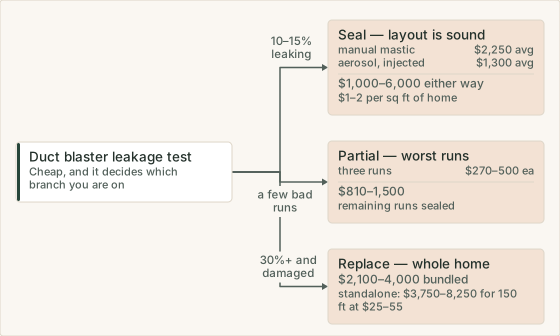
Replacement is the right call for ducts that are undersized, crushed, rodent-damaged, made of deteriorating flex from the 1980s–90s, or configured wrong for the new equipment's airflow. But if the layout is sound and the problem is leakage — the common case — sealing captures most of the energy and comfort benefit at a fraction of the price:
- Manual sealing (mastic and tape on accessible joints): about $2,250 average, per 2026 Angi/HomeGuide figures.
- Aerosol sealing (sealant injected under pressure, seals from inside): about $1,300 average, and it reaches joints buried in walls.
- Rule of thumb either way: $1–2 per square foot of home, $1,000–6,000 total depending on size and method.
A useful decision test: get a duct leakage number before believing a "must replace everything" pitch. Duct blaster testing is cheap, and a system leaking 10–15% seals well; ducts leaking 30%+ with damaged sections are genuine replacement candidates. Partial replacement is also legitimate — at $270–500 per run, replacing the three worst runs comes to $810–1,500, with the remaining runs sealed at the figures above. A bid sheet can price that option alongside full replacement.
What moves a duct bid inside (or outside) the range
- Access — an open basement or generous attic sits at the bottom of the range; crawl spaces, finished ceilings, and wall chases push toward the top, because labor is most of the price.
- Material — insulated flex duct is cheapest; sheet-metal trunk lines cost more per foot but last decades longer. A quote should say which is where.
- Demolition and patching — cutting and re-closing drywall is real money and is the usual culprit when a two-story quote doubles the rule-of-thumb number.
- Code items — new registers, mastic at every joint, and insulation to current code (R-6 to R-8 in unconditioned space) belong in the bid, not in a change order.
- Regional labor — the same BLS wage data behind our calculators varies about ±25% around the national median by state; coastal-metro duct bids run correspondingly higher.
Reading a bid in sixty seconds
Ask for three numbers: linear feet, run count, and the per-foot or per-run rate. Multiply. If the multiplication doesn't roughly reproduce the bid total, the difference is either named line items (demolition, insulation upgrades, disposal) or air. Then compare the rate against the ranges above: under $20 per linear foot bundled with a system job is a good price; $25–55 standalone is market; above $60 deserves a specific explanation, usually access. A contractor who measured your house will rattle these numbers off. One who priced it "by feel" from the driveway is guessing with your money.
Frequently asked questions
How much does ductwork replacement cost per square foot?
Roughly $1 to $2 per square foot of home when replaced as part of a system job: published 2026 guides put whole-home duct replacement on a standard 2,000 sq ft house at $2,100 to $4,000. Priced by the duct itself, expect $25 to $55 per linear foot installed, or about $270 to $500 per duct run.
Should I replace ductwork when replacing my AC unit?
If the ducts are leaky, undersized, or past about 25 years old, yes — the equipment change-out already covers mobilization and system commissioning, so bundled duct work is cheaper than a separate project later. If ducts are sound, sealing at $1 to $2 per square foot of home usually captures most of the benefit for a third of the price.
How long does duct replacement take?
An equipment change-out that reuses existing ducts is typically a one-day job. Add duct replacement and published guides put the same project at three to five days, because crews are working in attics, crawl spaces, and chases rather than swapping boxes.
Is duct sealing cheaper than replacement?
Substantially. Sealing runs $1,000 to $6,000 depending on home size and method — manual mastic sealing averages about $2,250 and aerosol (injected) sealing about $1,300 — versus $2,100 to $4,000 to replace the ducts on a typical 2,000 sq ft home, and replacement quotes climb further with difficult access.
Data sources
Duct cost bands: HomeGuide, This Old House, Angi, and Homewyse duct cost guides, 2026 editions, retrieved 2026-07-04. Equipment and labor context: the datasets behind our HVAC calculators — BLS OES 49-9021, May 2025, and HVACDirect published prices, July 2026. Figures are national planning ranges, not quotes.