Electrical panel upgrade cost calculator
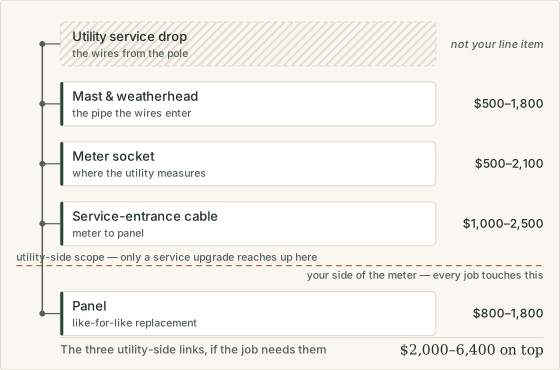
As of 2026, a like-for-like electrical panel replacement runs $800–$1,800 installed, while a full 100-to-200 amp service upgrade lands at roughly $2,400–$8,250. Most of that gap sits in the utility-side scope — meter socket, mast and weatherhead, and service-entrance cable — each priced as its own line item below. Bands derive from published contractor-cost guides and retail equipment prices, with BLS electrician wages shown as a regional cross-check.
Pick the job — a like-for-like panel replacement, a 100-to-200 amp service upgrade, a new 200A panel, or a subpanel — and get an itemized low / typical / high range: equipment, electrician labor, service-entrance work, and permit, each with its source.
Last reviewed 2026-07-22 · pricing data as of 2026-08 · how we build these numbers
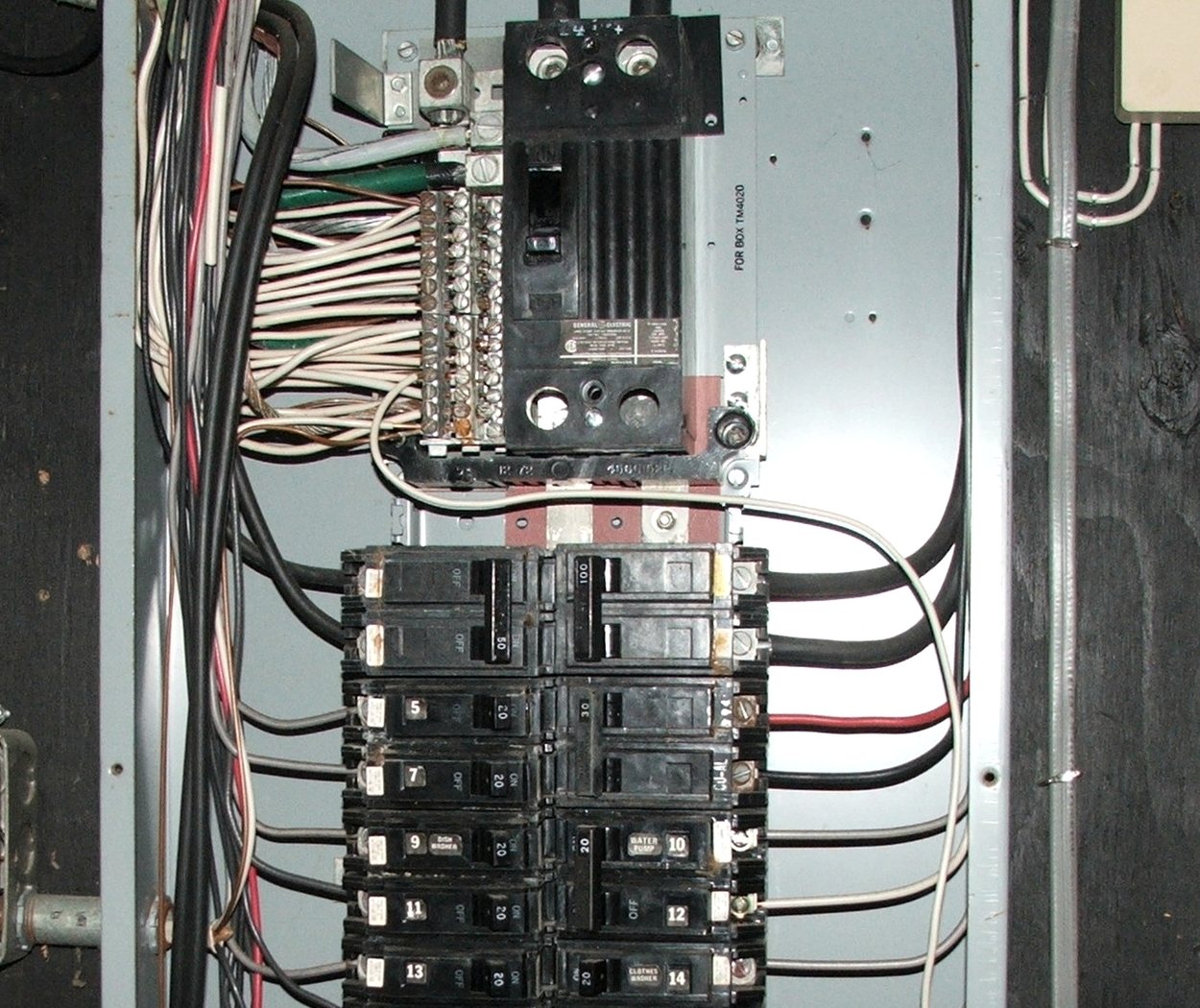
- Main breaker — what sizes the service. Going from 100 to 200 amps changes this and everything behind it, out to the meter
- Breakers — one per circuit, and every wire you can see gets re-landed on a swap — that is where the 4 to 12 hours go
- Panel — the box itself. A 200A load center retails for $223–$289 — the smallest line on a four-figure quote
How this estimate is built
Every number in this electrical panel replacement cost calculator is a published band, added in the open:
- Job base band. Each job type carries a low / typical / high installed band from 2026 contractor cost guides: like-for-like panel replacement $800–$1,800, a 100-to-200 amp service upgrade core of $1,300–$3,000 (panel and main breaker, before service-entrance work), and a new 200A panel at $1,800–$2,800. Where the guides publish it, we split the band into equipment and labor so you can see what the box costs versus the electrician's time.
- Legacy-brand override. If the existing panel is Federal Pacific (Stab-Lok) or Zinsco, the base band is replaced with the FPE/Zinsco band of $1,500–$4,500 — these jobs are quoted as full code-compliant replacements, not swaps.
- Service-entrance adders. Meter socket replacement ($500–$2,100), mast and weatherhead ($500–$1,800), service-entrance cable ($1,000–$2,500), and utility coordination ($0–$1,000) are each optional line items, because no two upgrades need the same set.
- Subpanel path. A subpanel is priced as an installed base (60A: $400–$1,000; 100A: $500–$1,500) plus a per-foot feeder rate — $4–$12/ft indoors, $8–$19/ft for a buried run to a detached structure — applied beyond the first 10 feet.
- Permit and inspection. A flat $75–$350 band closes every estimate. It is real money and it is not optional.
Data sources
Labor benchmark: BLS OEWS May 2025, occupation 47-2111 (Electricians), national median $30.38/hr, series OEUN000000000000047211108 — billed contractor rates of $60–$150/hr reflect that wage plus burden, overhead, and profit. Equipment: Home Depot, Lowe's, and Summit.com retail listings for Square D Homeline load centers and Milbank meter sockets, retrieved 2026-07-04. Equipment inflation: BLS PPI switchgear series PCU335313335313, +12.4% year over year through May 2026. Installed job bands: This Old House (2026-03-31), HomeAdvisor (2026-06-17), HomeGuide, Angi, and Homewyse (May 2026). Interpolated values are flagged in the methodology and in the dataset itself. Pricing data as of 2026-07.
Why a 100-to-200 amp upgrade costs more than a panel swap
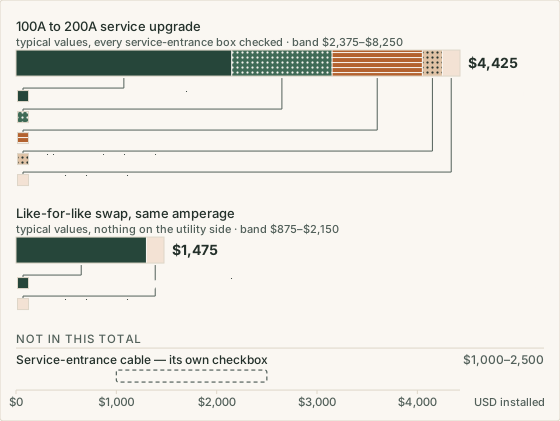
This is the question that confuses the most homeowners, so here is the worksheet. The panel box is nearly irrelevant: a 200A Square D Homeline load center with breakers retails for $223–$289, against $94–$118 for a 100A model. What you are paying for in an electrical panel upgrade from 100 to 200 amps is everything between the panel and the utility's wires:
| Line item | Like-for-like swap | 100 → 200A upgrade |
|---|---|---|
| Panel & breaker equipment | $100–$350 | $250–$600 |
| Electrician labor | $500–$1,300 (4–12 hr) | $800–$2,100 (10–20 hr) |
| Meter socket replacement | — | $500–$2,100 if needed |
| Mast & weatherhead | — | $500–$1,800 if needed |
| Utility coordination | — | $0–$1,000 |
| Permit & inspection | $75–$350 | $75–$350 |
| Total | $875–$2,150 | $2,375–$8,250 |
The upgrade also triggers a load calculation, and in jurisdictions on the 2020 or later National Electrical Code, section 230.85 requires an exterior emergency disconnect — one more reason recent quotes run above older published averages. Use the 200 amp panel upgrade estimator above with only the boxes your electrician actually flags; skipping an unneeded mast replacement moves the typical figure by around $900.
A second 2020-NEC item deserves its own line on the quote: section 230.67 requires a Type 1 or Type 2 surge protective device (SPD) integral to or adjacent to the service equipment for every dwelling service — and the rule applies when an existing service is replaced, not just on new construction. To be explicit about what our numbers carry: the job bands above do not itemize an SPD. A breaker-style or DIN-style whole-house SPD retails for roughly $70–$300, and because the electrician is already inside the panel, folding it into a panel or service job typically adds a few hundred dollars all-in — well under the $300–$700 published for fitting one as a stand-alone visit. If a bid in a 2020- or 2023-NEC jurisdiction shows no SPD line, ask where it went; a missing SPD is a failed inspection, not a saving.
Federal Pacific and Zinsco panels: cost and urgency
Federal Pacific Stab-Lok and Zinsco (Sylvania-Zinsco) panels are the two brands that change the conversation from "when it's convenient" to "before the insurance renewal." Their breakers have documented failure-to-trip histories, the designs are out of production, and there is no repair path — replacement is the fix. For budgeting, Federal Pacific panel replacement cost runs $1,500–$4,500 for most homes, with contractor-published quotes for full code-compliant 200A replacements reaching $2,800–$7,800 in markets where the exterior-disconnect rule and heavy service-entrance work stack up.
The insurance angle is what sets the timeline: many carriers now decline to write or non-renew policies on homes with these panels, and 30–90 day replace-or-lose-coverage notices are common once an inspection finds one. That timeline comes from insurance-agency guidance published through May 2025. If you check the FPE/Zinsco box above, the calculator prices the job on its own band rather than the standard swap band, because that is how electricians quote it.
Subpanel installation cost for a detached garage
A subpanel does not change your service size — it relocates capacity closer to where you use it, which is why a workshop, an accessory dwelling, or a detached garage with an EV charger usually wants one. Inside the house, a 60A subpanel 20 feet from the main panel is a modest job: roughly $400–$1,000 for the base plus $4–$12 per foot of feeder beyond the first 10 feet, plus permit. The detached-garage version is a different animal because the feeder goes underground: trenching and conduit push the run to $8–$19 per foot, the structure needs its own disconnect, and published all-in figures cluster at $1,000–$3,000. Run your actual distance in the calculator — on a 60-foot buried run, the feeder alone typically adds about $650.
Here is the same comparison itemized, using the exact bands the calculator prices with:
| Line item | Interior subpanel — 60A, 20-ft run | Detached garage — 100A, 60-ft buried run |
|---|---|---|
| Subpanel installed (base, first 10 ft of feeder included) | $400–$1,000 | $500–$1,500 |
| Feeder beyond the first 10 ft | $40–$120 (10 ft × $4–$12) | $400–$950 (50 ft × $8–$19) |
| Permit & inspection | $75–$350 | $75–$350 |
| Total | $515–$1,470 | $975–$2,800 |
The detached-garage column lands squarely inside the $1,000–$3,000 all-in figures contractors publish for that job — which is the point of showing the math: the distance and the trench, not the panel, are what you are paying for.
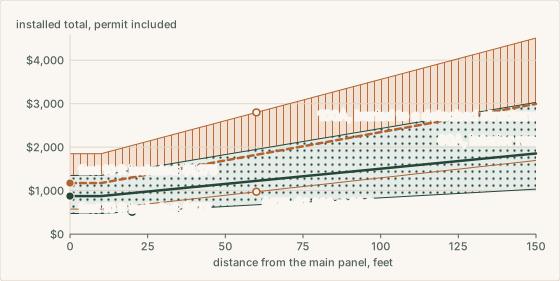
If the subpanel is for EV charging, size the circuit before the panel: our Level 2 EV charger installation cost guide covers the charger-side numbers, including when a load-management device lets you skip panel work entirely.
What moves your bill: state labor and equipment inflation
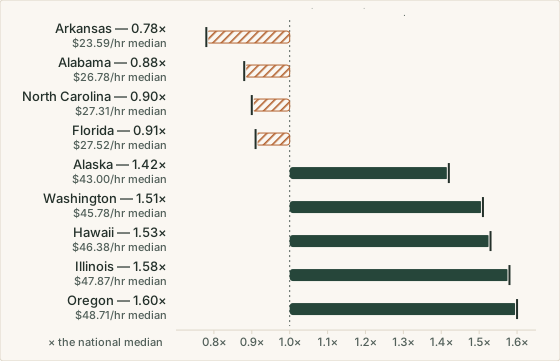
Two forces push a real quote away from the national bands. First, electrician labor is intensely local: BLS May 2025 medians run from $23.59/hr in Arkansas to $47.87 in Illinois and $48.71 in Oregon — a spread of roughly 0.8× to 1.6× the national median on the labor share of these jobs. Second, the equipment itself is inflating faster than almost anything else in a house: the producer price index for switchgear and panelboards rose 12.4% in the year through May 2026 and about 36% since January 2023, which is why cost guides last updated in 2023 undershoot today's quotes. Both effects are documented, with series IDs, in the dataset this page loads — see the full trail on our methodology page, and compare other projects on the calculator index.
Frequently asked questions
Why does a 100-to-200 amp upgrade cost more than replacing a panel?
The panel itself is not the difference — a 200A load center retails for $223–$289. A like-for-like swap ($800–$1,800) stays on your side of the meter, while a 100-to-200 amp service upgrade adds utility-side scope: heavier service-entrance conductors, usually a new meter socket ($500–$2,100) and mast ($500–$1,800), utility disconnect scheduling, and stricter inspection. Priced together, a full upgrade commonly lands at $2,400–$8,250.
How much does it cost to replace a Federal Pacific or Zinsco panel?
Plan on $1,500–$4,500 for most homes in 2026, and contractor-published quotes for code-compliant 200A replacements reach $2,800–$7,800 in some markets. FPE Stab-Lok and Zinsco breakers have documented failure-to-trip histories, and many insurers issue 30–90 day replace-or-lose-coverage notices once one is found, so this job rarely waits.
What does a subpanel for a detached garage cost?
Most detached-garage subpanels land at $1,000–$3,000 installed. The swing factor is the buried feeder: trenching plus conductor adds roughly $8–$19 per foot beyond the first 10 feet, and a detached structure also needs its own disconnect and usually conduit. By contrast, a 60A subpanel on a short interior run can come in near $950 including the permit.
Should a detached garage subpanel be 60 amp or 100 amp?
On cost alone the gap is modest: the installed base band is $400–$1,000 for a 60A subpanel against $500–$1,500 for 100A, while the buried run to the garage is priced from the same published band either way ($8–$19 per foot, with heavier conductor sitting at the top of it). Since the trench is dug once, many homeowners take the 100A headroom if an EV charger, welder, or heater could ever land in the garage — but a load calculation, not the panel price, makes the final call.
Do I need a permit to replace an electrical panel?
Yes — panel and service work requires a permit and inspection in nearly every U.S. jurisdiction, typically $75–$350. Unpermitted panel work is a common home-inspection flag at resale and can complicate insurance claims. For a service upgrade the utility must also be scheduled, because the meter is pulled.
Do I need a 200 amp panel for an EV charger?
Not always. Many 200A homes take a 40–50A Level 2 circuit with no panel work, and load-management devices can avoid an upgrade even on a 100A service. But if a load calculation shows your 100A panel is already near capacity, budget $1,300–$3,000 for the upgrade core before the charger circuit itself. Our EV charger guide walks through that decision.
Estimates on this page are planning ranges built from the published data above — they are not quotes, bids, or electrical advice. Panel and service work is licensed work in every state; get at least three written, itemized bids before committing.