How to read a roofing quote: a line-by-line checklist
Last reviewed 2026-07-05 · pricing data as of 2026-07 · how we build these numbers
Run your own numbers in the roof replacement calculator →
A roofing quote is a small technical document, and contractors know most homeowners read only the bottom line. That's a mistake — the bottom line tells you what you'll pay if nothing goes wrong, while the line items tell you what happens when something does. Here's how to read all of it, in the order that matters.
Before the quotes arrive
Run your roof through our calculator and write down three numbers: your square count, the typical band, and the high band. You're not expecting bids to match — you're establishing which questions to ask when they don't. A bid 30% above our high band isn't automatically padded, but the bidder should be able to say exactly why (steep-slope labor, triple tear-off, decking condition) without getting vague. It also helps to know what drives the spread before you read a single bid — our cost-factors guide ranks the seven levers so you can tell a real cost difference from a padded one.
The eight things a legitimate bid must itemize
- Measured squares, stated. If the quote doesn't state the roof's size, you can't compare it to anything — including other quotes. Ask every bidder for their square count; if two bidders measure the same roof 4 squares apart, make them reconcile it. At $450–750 per installed square, 4 phantom squares is a $1,800–3,000 disagreement hiding in plain sight.
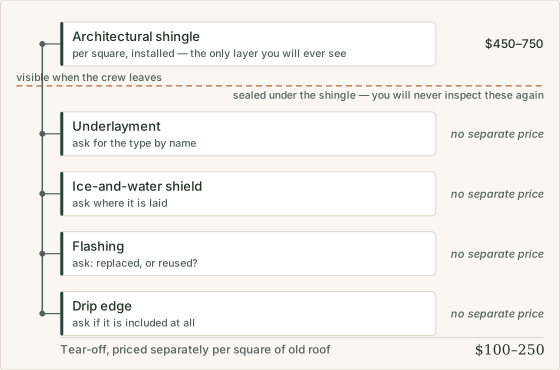
- Exact materials by product name. "Architectural shingles" is not a specification. You want manufacturer and product line, plus the underlayment type, ice-and-water shield locations, and drip edge — these cheap layers are where corners get cut invisibly. A bundle of name-brand architectural shingle retails around $43; the difference between the good underlayment and the cheap one is a few hundred dollars on the whole job, and it's the layer that decides whether a wind-driven rain reaches your decking.
- Tear-off scope and layer count. How many layers are being removed, and what disposal costs. Removal runs $100–250 per square, so on a 20-square roof this line is worth $2,000–5,000 — "roof-over" bids that skip tear-off should be dramatically cheaper and explicitly say so.
- Decking repair pricing, per sheet. The most important line on the page. Nobody knows the plywood's condition until tear-off, so the quote must state the price per replaced sheet (commonly $75–150). If it's not in writing now, it's a blank check later.
- Flashing: replaced or reused. Reusing old flashing around chimneys and valleys is a classic way to hit a low price and leak in three years. The bid should say "new flashing" where it means it.
- Ventilation work. Ridge vents, soffit baffles, or "matching existing" — stated, because ventilation errors void shingle warranties.
- Cleanup and magnetic nail sweep. Small line, real quality signal.
- Two warranties, separately. The manufacturer's material warranty and the contractor's own workmanship warranty (look for 5–10 years) are different things. A bidder who blurs them is hoping you won't notice.
Red flags that predict trouble
- A price with no square count — unverifiable by construction.
- Big deposit up front. Ten percent or material-order timing is normal, while 50% before a shingle arrives is not. Some states legislate the ceiling: California law caps home-improvement down payments at the lesser of $1,000 or 10%.
- "Today only" pricing. Real crews are booked weeks out; urgency is a sales tactic, not a schedule.
- Storm-chaser dynamics. Out-of-state plates and door knocks after hail. Some are legitimate; your workmanship warranty isn't, once they leave the state.
- "We'll handle your insurance claim" plus a request to sign an assignment of benefits — read that document like it's a mortgage, because you're signing away control of the claim.
- No license number or certificate of insurance on the paperwork. Verify both; an uninsured crew's fall is potentially your homeowner's liability. Ask for the certificate directly from the insurer, not a photocopy — lapsed policies photograph as well as active ones.
Comparing three bids that don't match: a worked example
Say three bids come back on the same 20-square architectural-shingle roof: $13,400, $16,200, and $21,900 — the first two inside our calculator's $11,900–21,500 planning band for that job, the third $400 above it, and all three $8,500 apart end to end. Normalize before judging:
- Same squares? Bid A measured 19 squares, bid C measured 23. Make them reconcile — at typical rates those four squares are a $2,000–3,000 spread.
- Same material line? Bid A quotes a builder-grade laminate, bid B the name-brand line with synthetic underlayment. That's a real difference worth paying for, not padding.
- Same tear-off and decking terms? Bid A's price assumes zero decking replacement and doesn't state a per-sheet rate; bid C includes an allowance for six sheets. On tear-off day, A's "cheap" bid can grow past B's honest one.
- What explains the rest? Bid C carries a steep-slope charge and new flashing throughout. If your roof is a 10/12 with three chimneys, C may be the only bidder who actually looked at it.
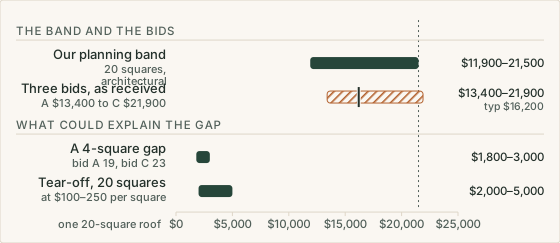
Most "cheap" bids stop being cheap once you price in the missing ice-and-water shield and the unwritten decking rate. When a normalized bid is still far below the others, ask yourself which line item is quietly absorbing the difference — because on roofs, the absorbing line is usually labor quality or flashing.
Questions that separate pros from pretenders
Four questions, sixty seconds each, and every good roofer answers them without friction: How many squares did you measure, and at what waste percentage? What's your per-sheet price for decking? Who exactly is on my roof — your crew or a sub, and who holds the workmanship warranty either way? What does the manufacturer require for the shingle warranty to actually apply? That last one is quietly powerful: premium warranty tiers often require specific underlayment, ventilation, and installer certification — a bidder claiming the warranty without pricing those items has already told you something.
The goal isn't the lowest number; it's the lowest number whose every line you understand. That's a bar most homeowners never set — and the entire reason this site shows its math.
Frequently asked questions
How many roofing quotes should I get?
At least three, in writing, on the same specification — same shingle line, same underlayment, same tear-off scope. Fewer than three and you have no way to tell an outlier from a market price; more than five and you are optimizing pennies while your roof leaks. Spread them across at least two weeks if you can, since a single storm or a slow week can move one bidder's pricing.
How much deposit is normal for a roofing job?
Around 10%, or an amount tied to the actual material order, is the common range. Some states regulate it — California caps the down payment on a home-improvement contract at $1,000 or 10% of the price, whichever is less. A contractor who wants 50% before a shingle arrives is financing their business with your money, and if they fold mid-season, you are an unsecured creditor.
What should a roofing quote include?
Eight things in writing: the measured square count, exact materials by manufacturer and product line (shingles, underlayment, ice-and-water shield, drip edge), tear-off scope and layer count, a per-sheet price for decking replacement, which flashing is replaced versus reused, ventilation work, cleanup and magnetic nail sweep, and both warranties — the manufacturer's on materials and the contractor's own on workmanship — stated separately.
What are the biggest red flags in a roofing bid?
A price with no square count (unverifiable by construction), a deposit far above 10%, "today-only" pricing, pressure to sign an assignment of insurance benefits, and paperwork missing a license number or certificate of insurance. None of these guarantees a bad job — together, any two of them predict one.