Asphalt vs. metal roof: cost per year, not just cost per square
Last reviewed 2026-07-05 · pricing data as of 2026-07 · how we build these numbers
Run your own numbers in the roof replacement calculator →
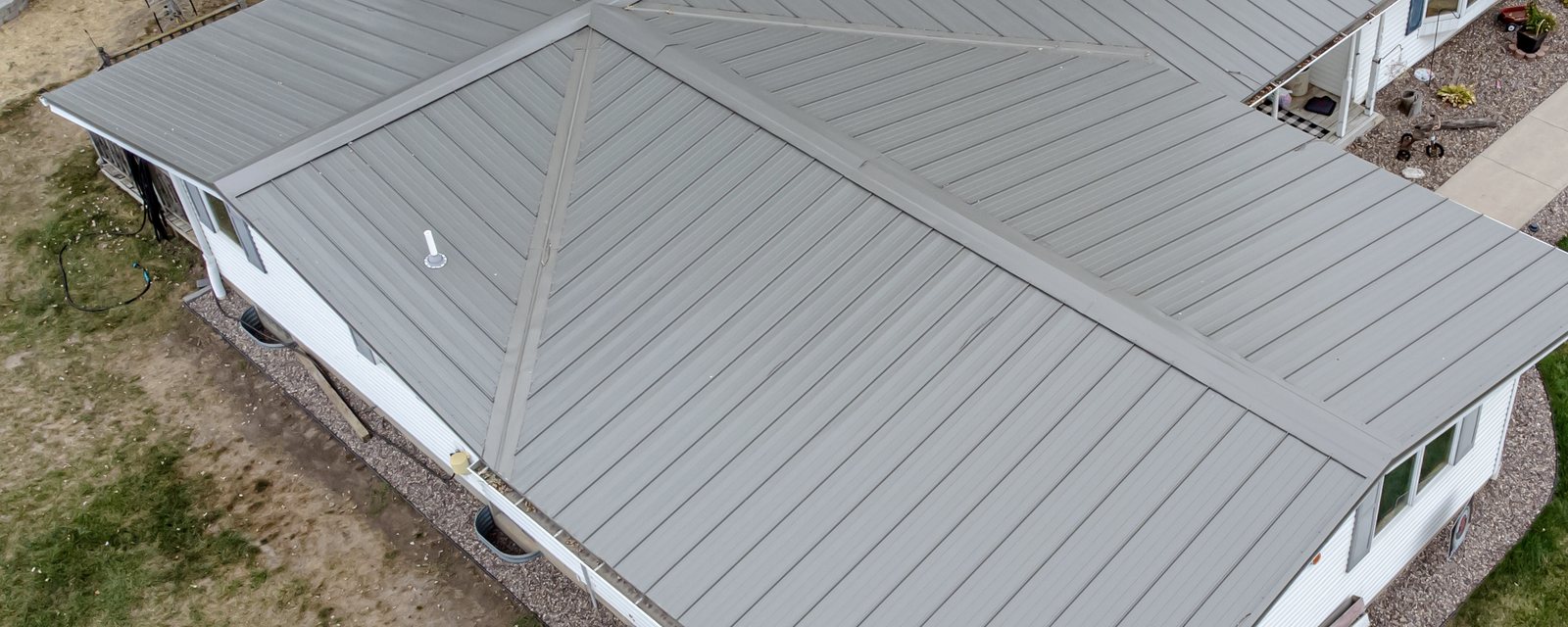
- Standing seam — the raised rib where two panels lock together — no fastener passes through the roof
- Hip — the sloping line where two roof planes meet — every panel here is cut to an angle
- Eave — the low edge where the roof drains — trim and gutter detail is priced here
Compared on the day you write the check, asphalt wins easily. Compared over the decades you'll own the house, the answer flips more often than most homeowners expect. The only honest comparison divides installed cost by expected years of service — so let's do that math with real numbers, and then look at the factors the math leaves out.
The upfront gap
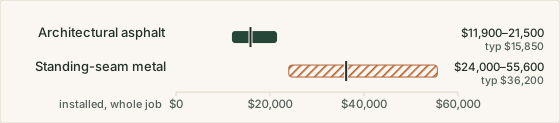
Our roof replacement calculator prices both materials off the same bands: installed cost per 100-square-foot "square", as of 2026-07. Architectural asphalt shingles run $450–750 per square, while standing-seam metal runs $1,000–2,300. On a 20-square roof — 22 squares after the standard 10% waste allowance — with single-layer tear-off, that works out to a total bill of roughly $11,900–21,500 for asphalt versus $24,000–55,600 for metal. The metal premium is real: commonly 2x and sometimes closer to 3x. If you may sell within five years, that gap is hard to justify — you'll pay for a lifespan the next owner enjoys.
The lifespan gap
Architectural asphalt shingles are typically warranted for 30 years but deliver a practical service life of 18–25 years depending on climate — sun, hail, and freeze-thaw cycles are the enemies. Standing-seam metal routinely serves 40–60 years, with the paint finish (not the panel) usually being the first thing to age. In hot-sun and hail-prone regions, asphalt's real-world lifespan sits at the low end of its range while metal's advantage widens.
The math that decides it
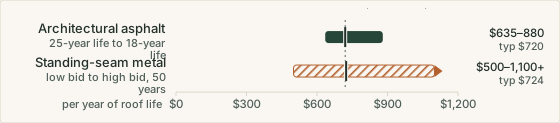
Take that 20-square roof at typical mid-band pricing, tear-off included, and divide by years of service. Asphalt: 22 effective squares × $575 + 20 squares × $160 of tear-off = about $15,900 installed; over a 22-year practical life that is roughly $720 per year of roof. Metal: 22 × $1,500 + the same tear-off = about $36,200; over 50 years, roughly $724 per year. At national-typical pricing, in other words, the two are within a few dollars a year of each other — a coin flip. Which is exactly why the inputs, not the averages, make the decision:
- If your asphalt roof would realistically make 25 years (mild climate, good attic ventilation), asphalt drops to about $635 a year and wins.
- If asphalt in your climate dies at 18 (hail alley, brutal sun), it costs about $880 a year and metal wins comfortably.
- If a metal bid comes in at the low band — competitive markets see standing seam near $25,200 on this roof — metal falls to about $500 a year and wins decisively.
- If the metal bid runs to the high band ($55,600), it costs over $1,100 a year and asphalt wins even at a short lifespan.
- If you finance the job, interest compounds on a bill that is $20,000 larger for metal — cost-per-year math quietly assumes cash.
One more term the simple division misses: every asphalt cycle you skip is also a skipped tear-off, disposal bill, decking-surprise risk, and week of crews on the lawn. Over a 44-year horizon, asphalt means buying the roof twice (the second time at future prices) plus a second removal; metal means buying once. If you plan to be in the house for decades, that second cycle — not the sticker — is where metal usually earns its keep.
What the per-year math leaves out
In metal's favor
- Insurance: some insurers discount premiums for impact-rated (Class 4) roofing in hail states — worth an actual phone call to your agent, since discounts of 5–20% on the dwelling portion compound over decades.
- Energy: reflective metal finishes cut summer cooling loads, meaningfully in the Sun Belt, marginally in the North.
- Resale timing: a 10-year-old metal roof is a selling point; an 18-year-old asphalt roof is a negotiation item that can cost you the price of the roof at closing.
In asphalt's favor
- Repairability: any roofer in your county can patch asphalt cheaply; standing-seam repairs need specialty crews and matching panels.
- Installer availability: a mediocre metal install is worse than a good asphalt install, and good metal crews are scarcer and book out further.
- Cash flow: $16,000 now versus $36,000 now is not an abstraction if it means borrowing.
A decision rule that holds up
If you expect to stay 15+ years, live in hail or wildfire country, and can pay without expensive financing — metal's total cost of ownership usually wins. If you may move within 5–10 years, or your market's buyers won't pay for a premium roof, architectural asphalt is the rational choice, not the cheap one. Either way, price your specific roof in the calculator with both materials and compare the bands side by side — the gap on your roof, not the national average, is what you're actually deciding about. And when the bids arrive, hold both kinds to the same standard with the quote checklist: a metal quote deserves line items exactly as much as an asphalt one.
Frequently asked questions
How much more does a metal roof cost than asphalt shingles?
Installed, standing-seam metal runs $1,000–2,300 per square against $450–750 for architectural asphalt (2026 bands) — commonly 2 to 3 times more up front. On a 20-square roof with tear-off, that is about $36,200 versus $15,900 at typical pricing.
Is a metal roof worth it on cost per year?
At typical 2026 pricing it is nearly a tie: about $720 per year for asphalt ($15,900 over a 22-year practical life) versus about $724 for standing seam ($36,200 over 50 years). The assumptions decide it — a low-band metal bid or a 60-year panel life swings metal ahead; an asphalt roof that reaches 25 years, or interest paid on financing the larger metal bill, swings asphalt ahead.
How long does a metal roof last compared to asphalt shingles?
Architectural asphalt is typically warranted for 30 years but delivers a practical 18–25 depending on climate — sun, hail, and freeze-thaw are the enemies. Standing-seam metal routinely serves 40–60 years, and the paint finish usually ages before the panels do.
Does a metal roof lower home insurance premiums?
Sometimes. Some insurers discount premiums for impact-rated (Class 4) roofing in hail-prone states, commonly 5–20% on the dwelling portion. Call your agent before deciding — an actual discount quote turns a vague selling point into a number you can drop into the cost-per-year math.