What actually drives roof replacement cost — 7 factors, ranked
Last reviewed 2026-07-05 · pricing data as of 2026-07 · how we build these numbers
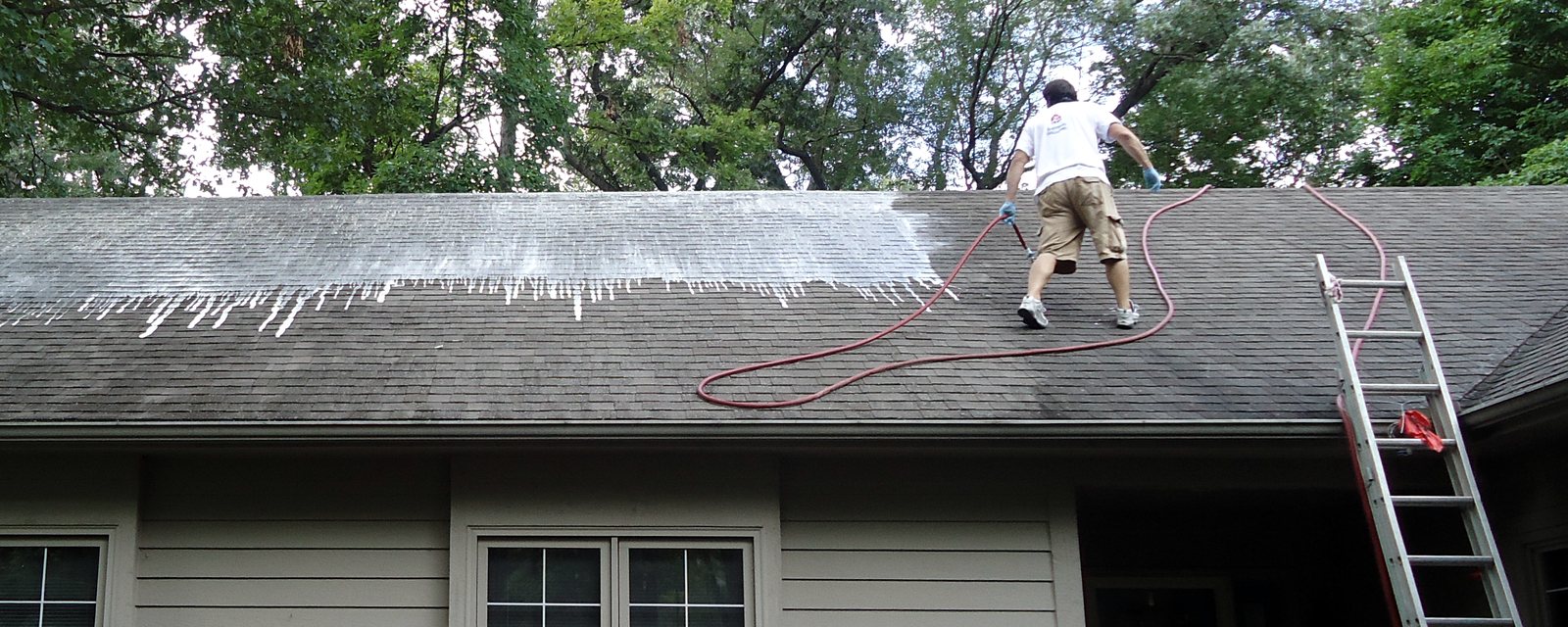
- Ridge — the top line where two planes meet — a crew works down from here
- Shingle — one course, laid overlapping from the low edge upward — material is counted in these
- Ladder — how the crew gets up and how material comes down — access shows up in the labor line
Run your own numbers in the roof replacement calculator →
When three contractors quote the same roof and the bids land $8,000 apart, the difference is rarely mystery or malice — it's that each one weighted the factors below differently. Here they are, ranked roughly by how hard each moves the final bill, so you can see where your money is going and where you have real choices.
1. Roof size — the multiplier under everything
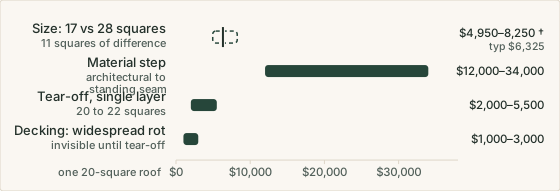
Contractors price roofs in "squares" — one square is 100 square feet of roof surface. A typical single-family home in the U.S. carries somewhere between 15 and 30 squares. Because nearly every other cost scales with squares, size is the biggest single driver: at a typical architectural-shingle rate around $575 per square installed, the gap between a 17-square ranch and a 28-square two-story colonial is over $6,000 before any other factor enters the picture. Note that roof surface is larger than the home's footprint — slope adds area, which brings us to the next factor.
2. Pitch — more surface, slower work, more safety gear
Pitch hits your bill twice. First, geometry: a 6/12 roof (rising six inches per foot) has roughly 12% more surface than the flat footprint below it; a steep 12/12 roof has over 40% more. Those aren't opinions — they're slope factors, √(1+(rise/run)²), and our calculator models them with pitch multipliers from 1.02 (flat) to 1.42 (steep). Second, labor: on anything above roughly 8/12, crews slow down, need harnesses and staging, and some contractors add a steep-slope charge of 10–30% on labor. That premium is one reason real steep-roof bids may still come in above the typical band even after the geometry is priced.
3. Material — a 3x to 4x decision
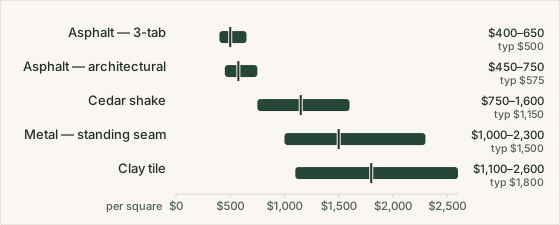
This is the largest factor you actually control. The bands below are our seed data as of 2026-07 — the same table the calculator prices with. Installed cost per square runs roughly $400–650 for basic 3-tab asphalt, $450–750 for architectural asphalt, $750–1,600 for cedar shake, $1,000–2,300 for standing-seam metal, and $1,100–2,600 for clay tile. On a 20-square roof (22 squares with waste), the jump from architectural asphalt to standing-seam metal is roughly $12,000–34,000 more before tear-off. Material choice also drives lifespan, which changes the long-run math entirely — see our asphalt vs. metal comparison for why the cheapest roof per year is not always the cheapest roof per decade. One more material note: tile and slate are heavy enough that some framing needs reinforcement first, a structural cost no roofing band includes.
4. Tear-off — what's under the old shingles
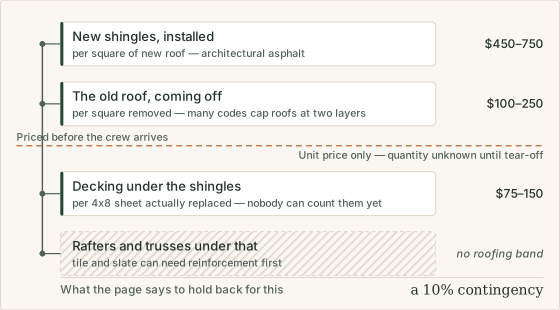
Removing and dumping the old roof typically adds $100–250 per square — $2,000 to $5,500 on a 20-to-22-square roof. If your home has two or three existing layers (common on older houses where a previous owner "roofed over"), removal costs rise sharply and many jurisdictions cap roofs at two layers by code, forcing full tear-off. Tear-off also carries the biggest surprise risk on the whole job: rotted decking is invisible until the shingles come off, and sheathing replacement is billed per 4x8 sheet — commonly $75–150 installed — on top of the contract price. A quote that states its per-sheet decking price in writing is protecting you; one that doesn't is holding a blank check. A prudent budget holds a 10% contingency for exactly this.
5. Complexity — every valley is a labor line
Two roofs with identical square counts can differ meaningfully in labor. Hips, valleys, dormers, skylights, chimneys, and multiple ridge lines all require cutting, flashing, and detail work that a plain gable roof doesn't. This is why a hip roof commonly runs 10–20% above a gable roof of the same size: every slope junction needs ridge caps, every plane ends in diagonal cuts, and the waste factor climbs. Complexity shows up in the numbers as waste — a simple gable may waste 5% of material to cut-offs, a cut-up hip-and-valley roof 15% or more. Our calculator's flat 10% waste assumption is a midpoint; if your roof looks like a wedding cake, expect the high band and ask bidders what waste percentage they carried.
6. Region and timing
Labor is local. The BLS wage data behind our bands puts the median roofer at $26.65/hr nationally, but state medians range from about 21% below that in Oklahoma, at index 0.79, to 41% above it in Illinois, at 1.41. Since labor is roughly 65% of a roofing job, a 1.20-index state prices about 13% above the national band. Timing stacks on top of geography: late summer and fall are peak season in much of the country as homeowners race the weather, while late-fall-through-early-spring bids can come in lower for the identical job. After a major hail or wind event, local prices spike for months as demand outruns crews — if you can wait out a post-storm surge, do.
7. Access and disposal
The quiet line items: a house with tight lot lines, landscaping to protect, or no room for a dumpster near the roof edge means material gets carried farther and debris handled twice. Multi-story homes add ladder and hoisting time that single-story ranches don't. It's rarely more than a few hundred dollars, but it explains small gaps between otherwise similar bids — and it's the factor bidders are least likely to itemize unless you ask.
Putting it together
Run your own numbers in the roof replacement calculator — it shows the exact worksheet, so when a real bid disagrees with it, you can find which factor (squares, pitch, material grade, tear-off) accounts for the difference and ask the contractor about that, specifically. Then put every bid through the quote checklist before you sign. That one-two combination — your own math, then their line items — is worth more than any national average.
Frequently asked questions
How much more does a hip roof cost to replace than a gable roof?
Commonly 10–20% more at the same square count. A hip roof has ridge caps on every slope junction, more starter courses, and diagonal cut lines on every plane, so it burns more material as waste (15% or more, against 5–10% on a plain gable) and more crew hours on detail work. Ask bidders for their waste assumption — it is the honest way to see whether they measured your roof or a generic one.
How much does it cost to replace roof decking?
Plan on roughly $75–150 per 4x8 plywood or OSB sheet installed, added to the contract price per sheet actually replaced. Nobody can see the decking until tear-off, so a legitimate quote states this unit price in writing up front. On a typical home, replacing a handful of bad sheets adds a few hundred dollars; widespread rot can add $1,000–3,000, which is why prudent budgets hold a 10% contingency.
Why do roofing quotes for the same house vary so much?
Because each bidder weights the factors differently: their measured square count and waste assumption, the exact shingle line and underlayment, tear-off and decking terms, crew cost, and how much margin the season allows. Two honest bids can sit $4,000 apart. Normalize before comparing — same squares, same material spec, same tear-off scope — and most of the gap usually disappears; whatever remains is margin or a line item someone left out.
When is the cheapest time of year to replace a roof?
Late fall through early spring in most U.S. markets, when crews are hungriest for work — early-spring bids commonly come in below peak-season prices for the identical job. Late summer and fall are peak season as homeowners race the weather, and prices spike locally for months after a major hail or wind event. If your roof can safely wait out a post-storm surge, waiting is usually worth real money.