Sump pump installation & replacement cost (2026): submersible vs pedestal
Last reviewed 2026-07-22 · pricing data as of 2026-08 · how we build these numbers
A sump pump is the cheapest insurance in your house right up until the night it isn't. The good news: replacing one is among the least expensive plumbing jobs you'll ever commission — if you know which of the three very different price tags applies to you. This guide separates them, prices submersible against pedestal honestly, and itemizes the add-ons that turn a $500 swap into a $2,000 invoice.
A dedicated CostCandor sump pump calculator is in research. Until it ships, this guide carries the numbers, built the same way as our calculators: published prices, named sources, dated.
The three price tags, and which one is yours
- Replacement in an existing pit: $650–$1,200 installed for a standard submersible — a band that sits inside Angi's 2026 typical replacement range of $645–$2,121. This is the common case: your pit, basin, and discharge line already exist, and the old pump is being unbolted and swapped.
- First-time installation: $800–$3,000, averaging about $1,100 (HomeGuide 2026). The spread depends almost entirely on the floor. An existing basin with drainage piping can bring a simple install down to roughly $500; cutting and jackhammering a concrete slab to dig the pit pushes projects to $2,500–$5,000.
- Replacement plus upgrades: $1,500–$3,000+ when a battery backup, discharge-line rework, or pit repair rides along.
National "average replacement cost" figures scatter widely — HomeAdvisor's 2026 survey centers on $309–$755, while Angi's lands at $1,365 with a typical range of $645–$2,121 — mostly because they blend those three project types. Anchor on your project type, not on a blended average.
Submersible vs pedestal: the honest comparison
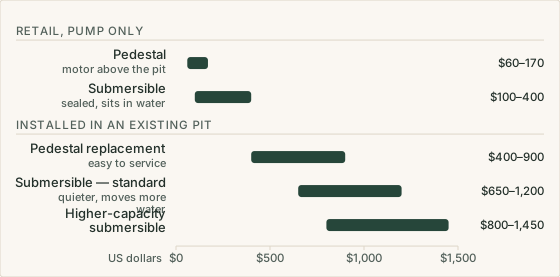
The pump itself is the smallest line on the invoice, and it's where the submersible-versus-pedestal decision starts. Pedestal pumps — the ones with the motor on a column above the pit — retail for roughly $60–$170. Submersibles, which sit sealed inside the basin under water, run $100–$400 at retail, per Angi's 2026 figures; the widely installed cast-iron Zoeller M53, a useful benchmark, streets at about $200–$230 in mid-2026.
Installed, the gap holds: a pedestal replacement runs $400–$900, a standard submersible $650–$1,200, and a higher-capacity submersible $800–$1,450. So why does the market keep choosing submersibles? Three reasons. They move more water per minute, which matters when a spring storm parks over your street. They're dramatically quieter, because the water muffles the motor — relevant if the pit sits under a finished basement's floor. And the sealed motor tolerates the occasional pit flood that would splash a pedestal motor. The pedestal's counter-argument is real, though: the motor lives out of the water where it's easy to service, and at these prices you can replace a pedestal unit twice for the installed cost of one submersible. For a rarely wet pit in an unfinished basement, that math is legitimate.
One sourcing note, in the spirit of showing our work: that three-tier installed split comes from thebasement.guide, a single niche basement site. We use its line-item survey for detail only, and it earns the citation because its bands sit inside Angi's broader $645–$2,121 replacement range and HomeAdvisor's simple-swap figures, which are the cross-checks.
What a replacement invoice actually contains
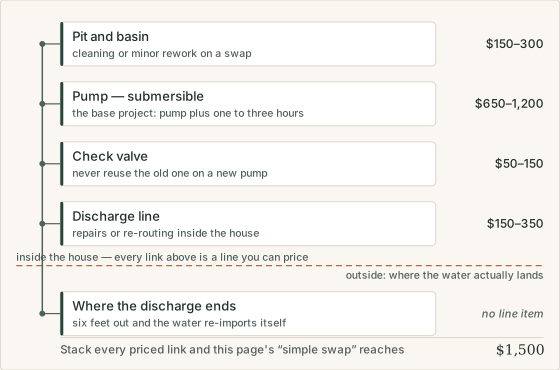
Take the standard case — submersible swap, existing pit — and read the invoice the way the installer builds it. The pump is $100–$400. Labor is one to three hours at billed plumber rates of $45–$200 per hour depending on your market. Those rates rest on the same federal plumber wage series that powers our water heater replacement calculator, credited in the sources below, and the 2:1 spread between low-wage and high-wage states shows up in sump quotes exactly the way it does in water heater quotes. Then come the small parts that separate a good install from a callback:
- New check valve: $50–$150 over base. Never reuse the old one on a new pump.
- Discharge-line repairs or re-routing: $150–$350.
- Pit cleaning or minor rework: $150–$300, per the same niche line-item survey noted above.
Stack every one of those and a "simple swap" legitimately reaches $1,500 without anyone padding anything.
The battery backup question
Pumps fail most often during exactly the storms that knock out power, which is why the backup conversation belongs in every replacement quote. A basic battery backup adds $350–$900; a longer-runtime configuration runs $700–$1,400; standalone professionally installed backup systems span $600–$2,000+, per Angi's 2026 figures, with the runtime-tier detail coming from the niche survey noted above. Against the cost of one finished-basement flood claim — and the deductible and premium consequences that follow — the backup is usually the highest-return line on the quote. If your basement holds anything you'd mind losing, price the backup first and the pump second.
When replacement is the wrong project
Two situations call for a bigger lens. First, if the pump runs constantly in dry weather, the problem may be groundwater routing or a failed check valve rather than the pump — pay for a diagnosis before paying for hardware. Second, if the pump shares a flooded mechanical room with corroded supply plumbing, sequence the work: a basement re-plumb means opening walls and moving lines, and it's cheaper to do pit work while the trades are already there. Our whole-house repipe calculator prices that larger project the same itemized way, so you can see whether bundling makes sense before asking a contractor to quote both.
How to read your quotes
Get the pump's brand and model in writing — "1/3 HP submersible" is not a specification, and the difference between a $100 thermoplastic unit and a $230 cast-iron one is invisible on a lump-sum quote. Ask whether the check valve is new, whether the float switch is vertical or tethered (tethered switches need a wider basin), and where the discharge terminates — a line that dumps water six feet from the foundation just re-imports the problem. And treat any quote far outside the bands above the way we treat every number on this site: ask to see the math. Every figure in this guide carries its source and date, and the methodology page explains how we build and refresh them.
Frequently asked questions
How much does it cost to replace a sump pump in an existing pit?
Most 2026 replacements in an existing pit run $650–$1,200 installed for a standard submersible and $400–$900 for a pedestal unit. Simple swaps with a mid-grade pump can land near the $310–$760 range national surveys report, while high-capacity submersibles with new check valves push $800–$1,450.
Are pedestal sump pumps cheaper than submersible pumps?
Yes, on both the unit and the installed price. Pedestal units retail for roughly $60–$170 versus $100–$400 for submersibles, and installed replacements run $400–$900 versus $650–$1,200. The trade-offs are noise, pumping capacity, and the motor sitting exposed above the pit.
How much does a sump pump battery backup cost?
A basic battery backup adds $350–$900 to a replacement, a longer-runtime setup $700–$1,400, and professionally installed standalone backup systems run $600–$2,000 or more. It is the single most-skipped line item that homeowners regret, because pumps fail most often in the storms that also knock out power.
How much does first-time sump pump installation cost?
Installing a pump where none exists runs $800–$3,000 with a national average near $1,100. If a basin and drainage piping already exist, simple installs can come in as low as about $500; if the crew has to saw and jackhammer a concrete floor, totals of $2,500–$5,000 are normal.
How long does a sump pump replacement take?
A straightforward swap in an existing pit takes about 1–3 hours; first-time installations take longer, especially in concrete floors. Plumbers bill roughly $45–$200 per hour depending on market, so the labor share of a simple swap is modest — the pump, valve, and discharge work drive the bill.
Data sources
Installation costs: HomeGuide sump pump installation cost guide, 2026. Replacement and backup costs: Angi sump pump replacement and battery backup cost guides, 2026. Cross-check survey data: HomeAdvisor sump pump cost data, 2026. Retail pump pricing retrieved July 2026. Labor wage base: BLS Occupational Employment and Wage Statistics for SOC 47-2152, plumbers and pipefitters, national median $30.67/hour as of May 2025. Line-item and tier detail: thebasement.guide's 2026 survey — a single niche site, used only where its figures sit inside the Angi/HomeAdvisor cross-checks above. Figures are national planning ranges, not quotes.