Sewer camera inspection cost — and what the video actually tells you
Last reviewed 2026-07-22 · pricing data as of 2026-07 · how we build these numbers
Run your own numbers in the sewer line calculator →
A sewer camera inspection is the cheapest decision in the most expensive corner of residential plumbing. For $125–$500, a technician pushes a self-leveling camera through your lateral and shows you, in live video, whether the pipe that everything in your house drains through is fine, failing, or already gone. Everything downstream of that video — a $0 decision, a $2,000 spot repair, or a $15,000 replacement — depends on reading it correctly. Here's what it costs, what it can and can't see, and how to turn the footage into a decision.
What a sewer camera inspection costs in 2026
The standalone national range is $125–$500, per HomeGuide's 2026 survey, with most jobs landing near $300. Three things move the price:
- Cleanout access. If your house has an accessible exterior cleanout, the camera goes straight in and you'll sit at the low end. No cleanout means entry through a roof vent or a pulled toilet — more labor, and the range shifts to $175–$750. If a plumber has to cut in a new cleanout, that's a separate job worth having anyway.
- Bundling. As an add-on to a buyer's home inspection, sewer scopes commonly price at $100–$250 — inspection companies are already on site and sell it as a package line.
- Extras. Three add-ons carry real cost: line locating, hydro-jetting or cabling to get the camera past a blockage, and a recorded report with footage. Locating puts a transmitter on the camera head, so a technician can mark the pipe's path and depth on your lawn with paint. Angi's 2026 all-in average of $996 looks alarming next to the $300 typical, but it bundles exactly these add-ons. Ask any quote to itemize; camera-only should sit near $125–$500.
One negotiating note: many contractors offer free camera inspections attached to repair quotes. The video is real, but the incentive isn't neutral — a company that sells $15,000 replacements is grading its own homework. For a decision this size, $300 for an independent scope with no repair business attached is cheap objectivity.
What the video actually tells you
The footage is only useful if you know what the defects mean. The six things a technician will call out:
- Root intrusion. Fine white roots at pipe joints mean the joints have already separated enough to leak — roots follow moisture. Occasional whiskers are manageable with periodic cabling; a root mat filling the pipe means the joint seals are gone and the clock is running.
- Bellies (sags). A section where the camera submerges and the picture goes underwater. Water standing in a belly collects solids and grease. Small bellies are livable with maintenance; a long, deep belly can't be fixed by lining — liners follow the pipe's shape — so it points toward excavation of that section.
- Offset joints. Pipe sections that no longer line up, common in old clay laterals as soil shifts. Minor offsets snag paper; major ones leak, invite roots, and can block the camera entirely.
- Cracks and breaks. Visible fractures or missing pipe wall. In clay or concrete pipe, cracks usually mean the surrounding soil is already migrating into the line.
- Scale and channeling in cast iron. Rust scale narrows the bore and snags debris. Channeling — a rusted-through groove along the pipe's bottom where water has eaten the invert — is the end-stage cast iron failure. A channeled pipe is draining through soil, not pipe, and is a replacement conversation, not a repair one.
- Grease and buildup. Not a pipe defect at all — a usage problem. Worth knowing before you pay for structural work you don't need.
Just as important is what the camera can't tell you. It sees the inside surface only: it cannot measure how much wall thickness remains in corroded cast iron, and it can't certify the stretch between two visible defects. It also can't tell depth or exact position without the locating add-on — which is worth buying if excavation is on the table, because bids get sharper when the bidder knows the dig is 4 ft down, not 8.
The sewer scope before buying a house
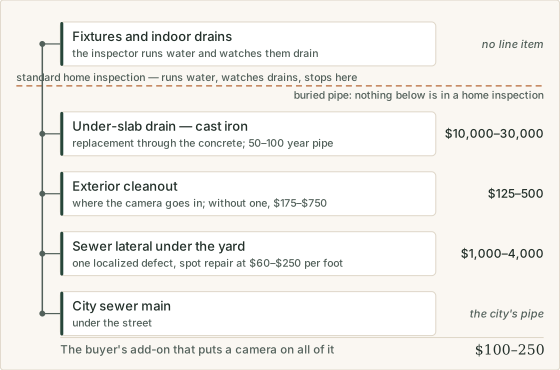
A standard home inspection stops at the foundation wall — the inspector runs water, watches drains, and never sees inside the lateral. That gap is exactly where the most expensive surprise in home buying lives. Order the scope when the house is older than about 1980 (the clay, Orangeburg, and cast iron era), when mature trees stand anywhere near the line's path, or when the seller's disclosure mentions even one backup or "slow drains."
The economics are lopsided in your favor. The add-on costs $100–$250. The problems it surfaces are five figures. Pre-1975 laterals are typically vitrified clay or Orangeburg, with 30–60 years of service life, and cast iron drains run 50–100 years, per HomeGuide's 2026 figures — which means the mid-century housing stock is failing on schedule. Under-slab cast-iron replacements commonly reach $10,000–$30,000. A dated video showing a channeled or root-choked line is concrete, negotiable evidence: buyers routinely convert a $250 scope into a credit worth ten to fifty times that, or walk away from a money pit entirely. If the video does show damage, run the footage's length and material through our sewer and water line calculator before the negotiation, so the credit you request is anchored to itemized numbers instead of a contractor's ceiling.
From video to decision: repair, line, or replace
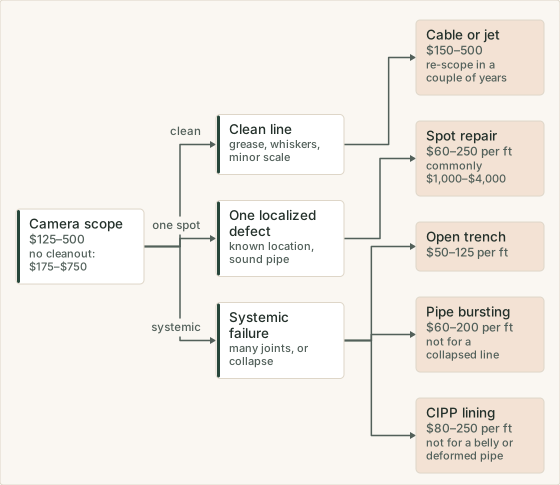
Read the footage through a three-branch tree:
- Clean line, or maintenance-only findings. Grease, light root whiskers, minor scale. Spend nothing structural. Cable or jet the line ($150–$500), fix the habits, and re-scope in a couple of years. Plenty of precautionary scopes end exactly here — no published survey counts the share, so we won't pretend to — and the certainty alone is worth the fee.
- One localized defect in otherwise sound pipe. A single break, offset, or short belly with a known location; this is where you want the locating add-on. Spot repair: excavate and replace that section at roughly $60–$250 per foot — commonly $1,000–$4,000 all-in depending on depth and surface. The discipline is to resist fixing one spot in a pipe that's failing everywhere; a spot repair in channeled cast iron buys you a new joint in a dying line.
- Systemic failure. Multiple defects, heavy root intrusion at many joints, channeled cast iron, or collapse. Now it's a lining, bursting, or open-trench replacement decision, and the per-foot math takes over: open trench runs $50–$125 per foot, pipe bursting $60–$200, CIPP lining $80–$250 — plus, for either trenchless method, a flat $1,000–$3,000 equipment mobilization — before restoration and permits. The video determines eligibility — a collapsed line can't guide a bursting head, a deep belly can't be lined, and deformed Orangeburg can't be lined either, because liners follow the host pipe's shape. Take the scope report to the calculator, price two methods against your surface conditions, and collect bids with the itemization already in hand.
One rule ties the tree together: never authorize the big branch from the small branch's evidence. A blockage cleared with a cable is not proof the pipe is sound, and a single root whisker is not proof it's failing. The camera exists so that a five-figure underground decision gets made on footage, not fear — insist on receiving the recording and the written findings, and keep both. The next owner's inspector will ask.
Frequently asked questions
How much does a sewer camera inspection cost in 2026?
$125–$500 is the typical standalone range, with $300 a reasonable planning number. If your house has no accessible cleanout, the camera goes in through a roof vent or a pulled toilet and the price climbs to $175–$750. Bundled with a buyer's home inspection, it often drops to $100–$250 as an add-on.
Should I get a sewer scope before buying a house?
Yes, if the home is older than about 1980, has large trees near the sewer path, or has any history of slow drains. A standard home inspection does not look inside the sewer lateral. A $100–$250 add-on that can surface a five-figure pipe replacement — under-slab cast-iron projects commonly reach $10,000–$30,000 — is one of the cheapest pieces of leverage in the entire transaction.
Does a camera inspection tell me exactly what repair I need?
It shows the defect and its location, but not everything. Video reveals roots, bellies, offsets, breaks, and scale, and a locator can mark position and depth from the surface. It cannot measure remaining wall thickness in cast iron or guarantee conditions between visible defects, so treat it as a decision tool, not a warranty.
Is the $1,000 sewer inspection quote I got normal?
It is high for a plain camera run but within the range Angi reports — about $996 average — when line locating, a cleaning to get the camera through, and a recorded written report are bundled in. Ask for the line items. A camera-only inspection should sit near $125–$500.
What if the camera finds one bad spot?
A single localized defect is a spot-repair candidate: a short excavated section typically runs $60–$250 per foot, often $1,000–$4,000 all-in. Multiple defects, channeled cast iron, or a sagging run usually push you toward lining or full replacement instead of chasing failures one at a time.
Data sources
Inspection and repair pricing: HomeGuide sewer-camera-inspection-cost and sewer-line-repair-cost surveys, 2026. Method and add-on pricing: Angi sewer inspection and trenchless replacement guides, 2026. Spot-repair per-foot ranges: HomeAdvisor, 2026. Pipe material service lives: HomeGuide's 2026 sewer guide and This Old House's 2026 sewer-line guide, whose cost data comes from Angi. Trenchless mobilization: NuFlow's 2026 trenchless cost guides. Retrieved 2026-07-04, updated 2026-07-22. Cost figures are planning ranges, not quotes.