A twenty-dollar permit, and a band that was never a band of permits
Published 2026-08-11 · records retrieved 2026-08-11 · our band fixed as of 2026-08 · how we build these numbers
Run your own numbers in the water heater calculator →
This is the smallest number on this site. Our water heater calculator itemises a permit at $25 low, $92 typical, $201 high, next to an appliance that costs a thousand dollars and labor that costs more. It is also, on the face of it, the easiest line we have ever had a chance to check: New Orleans types the permit by trade, writes the equipment into the description, publishes the fee collected, and releases the whole file under a public-domain dedication.
The check ran cleanly and we are throwing the result out. The reason is worth more than the result would have been.
1. What this record is
The dataset is rcm3-fn58, published by the City of New Orleans Department of Safety and Permits. Its metadata declares Creative Commons 1.0 Universal (Public Domain Dedication) — CC0, an outright waiver of copyright, and the cleanest licence position of any file in this ledger. Its Socrata row timestamp read 2026-08-11T04:52:01Z when we pulled on 2026-08-11, and the newest filing in it was issued the previous day.
Four columns do the work: type (the permit category the city assigned), description (free-text scope), landuse (the property's use class) and totalfees. The same file is the electrical half of our Norfolk and New Orleans record, retrieved the same day.
Two queries reproduce everything below. Both carry an upper date bound, so the window cannot grow with the calendar:
# every filing anywhere in the file whose description names a water heater,
# by permit type - this is what the cohort was carved out of
curl -s -G 'https://data.nola.gov/resource/rcm3-fn58.json' \
  --data-urlencode '$select=type,count(1) as n,avg(totalfees) as avgfee' \
  --data-urlencode "\$where=upper(description) like '%WATER HEATER%'" \
  --data-urlencode '$group=type' \
  --data-urlencode '$order=n desc'

# => Mechanical Fuel Gas 16096 (mean 49.47) · General Mechanical 2879 (96.08)
#    Renovation (Non-Structural) 334 (489.99) · Mechanical HVAC 118 · ...
# the cohort: a water heater and no other appliance, on a house,
# under a mechanical permit, issued since 2023
curl -s -G 'https://data.nola.gov/resource/rcm3-fn58.json' \
--data-urlencode '$select=totalfees,count(1) as n' \
--data-urlencode "\$where=upper(description) like '%WATER HEATER%' \
AND upper(description) not like '%STOVE%' \
AND upper(description) not like '%RANGE%' \
AND upper(description) not like '%DRYER%' \
AND upper(description) not like '%FURNACE%' \
AND upper(description) not like '%HVAC%' \
AND upper(description) not like '%A/C%' \
AND upper(description) not like '%AIR COND%' \
AND upper(description) not like '%GENERATOR%' \
AND upper(description) not like '%LOG%' \
AND (type='Mechanical Fuel Gas' OR type='General Mechanical') \
AND (landuseshort='RSFD' OR landuseshort='RSF2') \
AND issuedate >= '2023-01-01' AND issuedate < '2026-08-01'" \
--data-urlencode '$group=totalfees' \
--data-urlencode '$order=totalfees' \
--data-urlencode '$limit=50000'2. What it measures — and what it quietly does not
Unlike every roofing record we have published, this file has no denominator problem, because the fee is the quantity. There is no size to normalise by and nothing to divide. totalfees is what the city charged, so the self-reporting incentive that killed our Los Angeles re-roof record cannot operate here either.
What it does not measure is the inspection. New Orleans issues a mechanical permit and inspects against it, and nothing in the file says whether a re-inspection is billed separately; if it is, the real cost of “permit” on a New Orleans water heater is above what we print. Nor does the description say the tank's capacity often enough to split the cohort by gallons, which is what our earlier water-heater record used East Baton Rouge and Everett for.
And the fee is a schedule, flatly so. Sixty-four distinct values exist across the cohort, twelve of them carrying 95.15% of it, and one value — $20.00 — carrying 53.65% on its own. In our Los Angeles record that shape disqualified a column named valuation, because a valuation is supposed to be a price and prices spread. Here it confirms the column is what it says it is. A fee schedule is allowed to look like a fee schedule.
3. The cohort, and what we dropped
19,664 filings anywhere in the file name a water heater. We cut that four times.
To single- and two-family land use and to filings issued from 2023-01-01 to 2026-08-01: 3,473. To the two mechanical permit types that actually authorise the work — Mechanical Fuel Gas and General Mechanical — 3,308, dropping renovation permits whose description mentions a water heater in passing. Those matter: the 334 filings typed Renovation (Non-Structural) that name a water heater average $489.99, and a cohort that kept them would have shown our band comfortably validated by permits that are not for water heaters.
Then the bundled scopes. New Orleans's fuel-gas permits often cover a whole gas run: “new gas line, four outlets for stove, dryer, gas water heater, and A/C unit”. Excluding any description that also names a stove, range, dryer, furnace, HVAC, air conditioning, generator or gas logs drops 980 more and leaves n = 2,328. That exclusion is the one judgement call in this record, and it cuts against us: bundled jobs cost more to permit, so keeping them would have raised the median we are about to compare against.
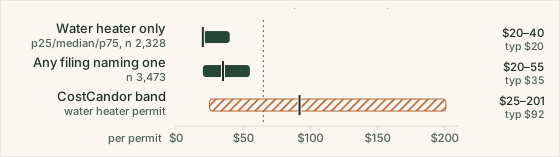
We print the wider cohort too, and it says the same thing more slowly: across the 3,473 filings before the type and bundling cuts, the quartiles are $20.00 and $55.00 with a median of $35.00.
4. The distribution, and our band on the same axis
| New Orleans, water heater only, n = 2,328 | Figure | What it is |
|---|---|---|
| Minimum fee in the cohort | $20.00 | Also the p10, the p25 and the median |
| Most common fee | $20.00 — 1,249 (53.65%) | Then $40.00 (298, 12.80%) and $35.00 (242, 10.40%) |
| p75 / p90 / p95 | $40.00 / $65.00 / $87.00 | Mean $38.06, maximum $2,988.00 |
| Median by year of issue | 2023 $25.00 · 2024 $20.00 · 2025 $20.00 · 2026 $20.00 | n = 842 / 628 / 520 / 338 |
| Wider cohort, before the cuts | $20.00 / $35.00 / $55.00 | p25 / median / p75 on n = 3,473 |
| Filings at or above our low, $25 | 1,079 (46.35%) | The majority of the cohort is below our floor |
| Filings at or above our typical, $92 | 111 (4.77%) | At or above our high, $201: 33 (1.42%) |
| Our band — water heater permit | $25 / $92 / $201 | low / typical / high, national, asOf 2026-08 |
Taken at face value that is a total failure of the band at all three points, and four calendar years hold it steady. Do not take it at face value. Read the last row against its own source field first.
5. Verdict
Verdict
(C) Comparison rejected — the record is sound and the band is not a band of permit fees.
Our data file states where the three numbers came from: PermitCalculator water-heater-permit-cost 2026 survey of 27 US cities: average $92, range $25 (Boston) to $201 (Columbus). Written out, that is: our low is Boston's figure, our high is Columbus's figure, and our typical is the mean across 27 cities. Three cities' worth of information, arranged to look like a distribution. They are not the 10th, 50th and 90th percentiles of anything, and no quantity of New Orleans filings can move a number whose units are “city” rather than “permit”.
That is why nothing changes here. Setting the low to $20 because New Orleans's mode is $20 would replace a 27-city construct with a one-city one and call it an improvement. Our Chicago record made the same refusal for the same reason and we are not going to abandon it the first time the arithmetic would be flattering.
What this record does establish is a defect in the label rather than in the arithmetic. Read as the spread between city averages, $25 to $201 is probably fine, and New Orleans does not contradict it — a city whose commonest permit is $20 can easily average $25 or more once tankless conversions and gas-line work are counted. Read as a calculator line, next to an appliance price and a labor band, it says this is what your permit will cost, and in New Orleans our $92 typical is 4.6 times the $20.00 median these filings actually paid, and our $25 low sits above 53.65% of them. The fix is a better source — a published national schedule of collected fees, which we have not found — and until there is one, the honest thing is to say in public that this line is weaker than the numbers around it.
Two of our permit lines moved this week on files of this kind. This one does not, and the difference is not the strength of the evidence. It is that the electrical band and the plumbing band both had sources that could produce a different number, and this one does not.
6. If you are replacing a water heater in New Orleans
Ask for the permit, and do not let the price of it become the argument. The city files these under a fuel-gas mechanical permit — 16,096 of them name a water heater — so a contractor who tells you no permit is needed is contradicted by a public file you can query in one line. What the permit gets you is an inspection of the gas connection, the venting and the relief valve, which is the part of a water-heater installation that can kill someone, and it costs about what a pizza costs. If a bid carries a permit line of $150 or more in New Orleans, ask what it covers; if a bid carries no permit line at all, ask whether one is being pulled. Elsewhere, look up your own city's fee schedule rather than trusting our $92, and read our East Baton Rouge and Everett record for what the rest of the installed price does. Our water heater calculator itemises the appliance, the labor and the adders separately, so you can replace this line with your own city's number and leave the rest alone.
Frequently asked questions
How much is a water heater permit in New Orleans?
Twenty dollars, most of the time. Across 2,328 mechanical permits issued between January 2023 and July 2026 on single- and two-family properties, whose description names a water heater and no other appliance, $20.00 is the minimum, the 10th percentile, the 25th, the median, and the single commonest value — 1,249 filings, 53.65% of the cohort. The 75th percentile is $40.00, the 90th is $65.00 and the 95th is $87.00. Sixty-four distinct fee values exist in the whole cohort and twelve of them carry 95.15% of it.
Then why isn't this a failed band check?
Because our band is not measuring the same thing. The permit line in our water-heater calculator reads $25 low, $92 typical, $201 high, and its source field says exactly where those came from: a 2026 survey of 27 US cities with an average of $92 and a range from $25 in Boston to $201 in Columbus. Those are three cities' figures — a minimum across cities, a mean across cities, a maximum across cities. They are not percentiles of permits, and a household does not pay a cross-city average; it pays one city's schedule. New Orleans has now shown us one, and it sits below all three. That is a finding about how the band was built, not a measurement that can replace any of its numbers.
Does that mean the numbers are wrong?
It means the label is. Read as what they are — the spread between city averages — $25 to $201 may well be right, and New Orleans does not contradict it: a city whose commonest fee is $20 could easily average $25 or more once the tankless and gas-line jobs are counted. Read as what a calculator line implies — this is what your permit will cost — our $92 is 4.6 times the median fee this cohort actually paid, and 53.65% of its filings fall below our $25 low. We are leaving the numbers and recording the mismatch, because replacing a 27-city construct with one city's schedule would make the band worse, not better, and inventing a national figure from Louisiana is the exact move this ledger exists to prevent.
Is a $20 permit even worth putting in an estimate?
On the total, no. A tank swap in our calculator runs into four figures and $20 disappears into it. On the bid, yes, for a different reason: the permit is the cheapest proof that an inspection happened. New Orleans files these under a mechanical fuel-gas permit and 16,096 of them exist in the file, so a contractor telling you a water heater does not need a permit in that city is contradicted by a public record you can query in one line. The number on the line matters much less than the line existing.