Cincinnati priced 4,865 water service replacements and never wrote down a foot
Published 2026-08-11 · records retrieved 2026-08-11 · our band fixed as of 2026-07 · how we build these numbers
Price a water line run in the sewer and water line calculator →
Almost everything on this site is checked against a building permit, and a permit records what somebody declared a job would be worth. This file is different, and better. Greater Cincinnati Water Works runs a program that replaces the private-side water service line — the pipe from the property line to the house, the smaller sibling our calculator prices at $40 to $125 per foot — and it publishes the contracted amount for every one. Not a declaration. A price somebody agreed to.
There are 4,865 of them marked complete. It is the largest and cleanest cohort this format has ever had, on exactly the right product, and it cannot check our band, because in sixteen columns nobody ever wrote down how long the pipe was.
1. What this record is
Greater Cincinnati Water Works — private-side lead service line replacement, resource b4xq-u3su at data.cincinnati-oh.gov. Four fields do the work: amount, status, replacement_date and adminarea. Its license is unverified. Both license and licenseId are null, the dataset carries no attribution statement, and the portal's own footer links only to the platform vendor's terms of service rather than to a city open-data policy. We publish group statistics from it and quote no row; the record banks no number from it either, which is the next section's problem.
Texas Department of Transportation — bid tabulations, resource de7b-7dna at data.texas.gov, appears second and for one reason: it states a quantity in linear feet and a unit price for pipe on the same row. Only one other file we opened does — Hawaii's highway bid tabs, which carry two usable pipe rows in total. Fields bid_item_description, measurement_unit, bid_item_quantity, bid_item_unit_price_amount, engineer_s_estimate_unit, low_bidder_flag, county and project_actual_let_date. Attribution reads TxDOT; the license field is null here too. Both retrieved 2026-08-11.
The Cincinnati file carries a street address and the name of the selected plumber on every row. Neither column is requested below, no row is quoted, and every figure on this page is a group statistic over hundreds or thousands of filings.
# Cincinnati — the whole file, and the completed cohort
curl -s -G 'https://data.cincinnati-oh.gov/resource/b4xq-u3su.json' \
  --data-urlencode '$select=count(1)'

# => [{"count_1":"7215"}]

curl -s -G 'https://data.cincinnati-oh.gov/resource/b4xq-u3su.json' \
  --data-urlencode '$select=count(1),min(amount),max(amount)' \
  --data-urlencode "\$where=status='Complete' AND amount > 0"

# => [{"count_1":"4865","min_amount":"1467","max_amount":"39955"}]

# the rows the analysis reads. No address and no plumber name.
curl -s -G 'https://data.cincinnati-oh.gov/resource/b4xq-u3su.csv' \
  --data-urlencode '$select=amount,status,replacement,adminarea,replacement_date' \
  --data-urlencode "\$where=status='Complete' AND amount > 0" \
  --data-urlencode '$limit=50000' > cincinnati_service_lines.csv
# Texas — every linear-foot sewer or water item a low bidder priced
curl -s -G 'https://data.texas.gov/resource/de7b-7dna.csv' \
--data-urlencode "\$select=project_id,county,project_actual_let_date,\
bid_item_description,bid_item_quantity,bid_item_unit_price_amount,\
engineer_s_estimate_unit" \
--data-urlencode "\$where=measurement_unit='LF' AND low_bidder_flag=true \
AND (upper(bid_item_description) like '%SEWER%' \
OR upper(bid_item_description) like '%WATER LINE%' \
OR upper(bid_item_description) like '%WTR LINE%' \
OR upper(bid_item_description) like '%WATERLINE%')" \
--data-urlencode '$limit=50000' > txdot_lf_items.csv
# 273 rows. Section 3 says which 38 of them are pipe going into
# the ground rather than pipe coming out of it.2. What this record measures — and what it quietly does not
There is no length anywhere in it. The Cincinnati file has sixteen columns: an address, the selected plumber, the amount, a status, an emergency flag, a replacement type, four dates, a neighborhood, a municipality, two material codes and an internal branch number. Not one is a length, a pipe diameter, a depth or a method. A per-foot band cannot be divided into a total that has no divisor, and no filtering makes one appear.
The material codes are undocumented and unused here. On a lead service line program the modal privatematerialtype is CU — copper — which most plausibly records the material after replacement rather than before it. The file does not say, so this page reads nothing from that column and splits nothing by it.
An administered market is not the open market. The plumbers here are working inside a utility program with its own quoting process, deadlines and acceptance steps, which is visible in the status column: alongside the 4,866 marked Complete sit 1,611 marked Do Not Replace, 362 Pending Quote and 275 Owner Accepted. That is not a schedule of fixed fees — the amounts take 1,495 distinct values and the most common of them, $3,200, holds only 3.6% of the cohort — but it is not the number a homeowner would get by calling three plumbers either.
The price is moving, and our band has one stamp. Grouped by replacement date, the median runs $5,150 in 2018, $3,800 in 2019, $3,389 in 2020, $3,250 in 2021, $3,269 in 2022, $3,049 in 2023, $3,210 in 2024, $3,369 in 2025 and $5,389 across the 389 rows dated in 2026. A five-year decline and then something close to a doubling. The file offers no explanation and neither will we; the 2026 rows are also a partial year. Any single figure quoted from this cohort is an average over that history.
On the Texas side the caveats are shorter and heavier. The work is utility relocation inside a highway project, so traffic control, bypass pumping and prevailing-wage labor are inside the unit price. The quantities are municipal: the sanitary sewer items run to a median of 174 linear feet and a maximum of 5,706. And the sample is concentrated — 10 of the 21 sanitary sewer rows come from Harris County lettings and 11 of the 17 water line rows from a single Maverick County letting on 2026-04-07.
3. The cohort, and what we dropped
Cincinnati needed almost no filtering, which is the other thing that makes it unusual. Of 7,215 rows, 4,866 carry a status of Complete and 4,865 of those a positive amount; the single exception has no amount at all. Nothing else was dropped, because there is nothing else to drop on — no scope text to disqualify, no bundled trades, no declared-value placeholders. The cohort's replacement dates run 2018-06-01 to 2026-07-29 and it spans 70 distinct administrative areas.
The Texas file needed a great deal. Of the 1,316 linear-foot rows whose item text mentions a sewer or a water line, 273 belong to a low bidder — the rest are losing bids on the same items, which would count the same job several times. From those, items that remove, abandon, clean, televise, grout, plug, cap, restrain or connect pipe were dropped, along with manholes, casings and heat-traced lines, because none of them is pipe being installed. That leaves 21 sanitary sewer items across 8 projects in 6 counties, let between 2024-08-02 and 2026-05-06, and 17 water line items across 3 projects in 3 counties, let between 2025-09-05 and 2026-06-02. Between them they cover 16,176 and 16,641 linear feet of pipe.
4. The distribution and our band on the same axis
The Cincinnati cohort is tight. Its 10th percentile is $2,900, its 25th $3,099, its median $3,340, its 75th $4,215 and its 90th $6,112, against a minimum of $1,467 and a maximum of $39,955. The middle half spans 1.36 times from end to end — narrow enough that if the run length were driving the price, service lines in Cincinnati would all have to be about the same length.
They are not, and the file hints as much. Sorted by neighborhood, the twelve areas with the most replacements return medians from $3,249 to $3,988 — a spread of 1.23 times across places whose lot depths and setbacks are visibly different, from the dense blocks of CUF to the deeper lots of Hyde Park. That is weak evidence, because a neighborhood is a poor proxy for a pipe run. It points the same way as the sewer-side record on this site, where the run length was written down and still did not price the job.
Now put our band next to it. Our water open-trench rate is $40 / $75 / $125 per installed foot, and the calculator multiplies it by a run the reader supplies. Ask what run each of our three rates would need to reproduce Cincinnati's quartiles:
| Our rate | Length that reaches p25 ($3,099) | … the median ($3,340) | … p75 ($4,215) |
|---|---|---|---|
| Low, $40/ft | 77.5 ft | 83.5 ft | 105.4 ft |
| Typical, $75/ft | 41.3 ft | 44.5 ft | 56.2 ft |
| High, $125/ft | 24.8 ft | 26.7 ft | 33.7 ft |
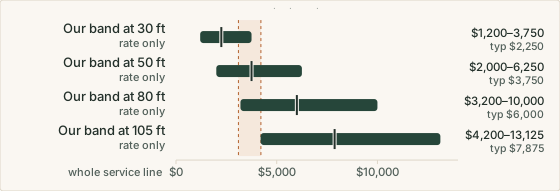
Every one of those nine numbers is an ordinary residential service line. Our band explains the whole interquartile range of 4,865 real contracted prices at any run between 25 and 105 feet, and it would have done so no matter what the band said, because the reader supplies the length that makes it fit. Read from the other direction, the same fact: our rate alone gives $1,200 to $3,750 at 30 feet, $2,000 to $6,250 at 50, $3,200 to $10,000 at 80 and $4,200 to $13,125 at 105 — four bands, and Cincinnati's middle half runs through all four. That is the figure at the top of this page, and it is a picture of a test that could not fail.
Texas has the denominator Cincinnati lacks. Its low bidders installed sanitary sewer pipe at a minimum of $70.00 per foot, a 25th percentile of $125.00, a median of $141.50, a 75th of $230.00 and a maximum of $492.50; water line at $43.00, $70.00, $115.00, $190.00 and $389.70. Both medians sit inside or beside our residential bands — $141.50 against a sewer open-trench high of $125, $115.00 against a water band of $40 to $125.
That agreement is worth nothing, and the same file says why. Take the closest thing to a residential size, a 6-inch sanitary sewer: the winning bids were $98.00 in Montgomery County, $109.42 in Johnson, $146.00 in Montgomery again, $175.00 in Cameron and $338.10 in Harris. The same nominal item, ordered from the same specification book, at 3.45 times the price depending on where the highway was. The 6-inch water line items do it too, at $67.00 in Maverick and San Patricio against $125.26 in Dallas. And the state's own estimators cannot predict any of it: the ratio of winning bid to engineer's estimate runs from 0.22 to 2.82 on the sewer items and 0.18 to 2.25 on the water items.
A number that varies by a factor of three for the same pipe in the same state, priced with traffic control and thousands of feet of scale inside it, cannot adjudicate what a plumber charges to cross a front yard. It lands near our band by coincidence, and a coincidence is not a check.
5. Verdict
Verdict
(C) Comparison rejected — the file that has the price has no length, and the file that has the length is pricing municipal mains rather than a house service.
The band above is the band as it stood when this check ran, fixed as of the 2026-07 stamp on our sewer-line data, which predates the 2026-08-11 retrieval. It is unchanged by this record.
The low end of our water open-trench band, $40 per foot, is flagged in our own data file as interpolated rather than surveyed — a derived endpoint, not a figure anyone published. It was the number this record set out to test, and this record leaves it untested. So does the rest of the band.
What Cincinnati does establish, without touching a per-foot rate, is that a whole-job price for this work has a strong middle: 4,865 completed replacements with a middle half of $3,099 to $4,215. That is a fact about the job worth having on the site, and it is deliberately not banked as a band check, because turning it into one requires a run length that 4,865 rows decline to supply.
6. If you are replacing a water service line
Ask for the length in writing, on the quote, in feet — from where to where. It is the one number that makes two bids comparable and the one number that a whole industry of public files omits. If the plumber will not state it, the per-foot rate in the bid means nothing you can check.
Ask where the responsibility line falls. The Cincinnati file exists because the public side and the private side of a service line are two different jobs owned by two different parties, and the amounts above cover only the private side. A quote that silently includes or excludes the run from the curb stop to the main is a quote for a different job than the one next to it.
And take the Texas spread as the reason to collect more than one bid rather than as a price. If contractors bidding a specified, drawn, publicly advertised 6-inch sewer item under the same state specification come in a factor of three apart, the spread on an undrawn residential job in your yard is not going to be smaller.
Frequently asked questions
What does replacing a water service line actually cost?
In Cincinnati, where a utility program publishes the contracted amount for each one, the middle half of 4,865 completed private-side replacements ran $3,099 to $4,215 with a median of $3,340. That is the whole job as the plumber priced it, not a per-foot rate, and it is one city under one program's quoting rules. It is also drifting: the median fell from $5,150 in 2018 to $3,049 in 2023 and then rose to $5,389 across the 389 replacements dated in 2026.
Why can a file with 4,865 real prices not check a cost band?
Because our band is priced per linear foot and the file has no feet. Sixteen columns record an address, a plumber, an amount, a status, dates, a neighborhood and material codes; none records a length, a pipe diameter or a method. To compare, the reader has to supply the run length, and the answer changes with it: our typical rate of $75 per foot reproduces Cincinnati's median at 44.5 feet, our low reproduces it at 83.5, our high at 26.7. All three are ordinary service lines, so the comparison passes whatever we do. A test that cannot fail is not a test.
Do bid tabulations for municipal water and sewer mains help?
They have the denominator and not the product. TxDOT's bid tabulations publish a quantity in linear feet and a unit price for every item, and its low bidders installed sanitary sewer pipe at a median of $141.50 per foot and water line at $115.00. Those numbers sit right on our residential bands, which is the trap rather than the confirmation: a 15-inch main laid 5,706 feet at a time in a highway right-of-way, with traffic control and bypass pumping in the price, is not a 4-inch lateral across a front yard. The same nominal 6-inch sanitary sewer item was bid at $98.00 in one county and $338.10 in another.
Did this record change the water line bands?
No. Nothing in either file can move a per-foot number, so nothing moved. The low end of our water open-trench band, $40 per foot, is marked in our own data as interpolated rather than surveyed, and it stays marked that way — this record neither supports it nor knocks it down. What would settle it is a file that carries the amount and the run length on the same row, and the sewer side of this site now has two of those, in San Francisco and Everett.